


 GDPR compliant
 HIPAA compliant
CherwellServiceNow
Cherwell to ServiceNow migration
ITSM specialists move your incidents, service requests and problems into ServiceNow, check a sample with you first, and count every record on both sides.
Scope my migration
Free sample migration of 100 of your records, plus a fixed quote within 24 hours.
Last updated October 2026 · 14 object types mapped
- 1000+migrations
- 15 yearsof collective experience
 SOC 2 Type IIGDPR compliantHIPAA compliant
Cherwell to ServiceNow at a glance
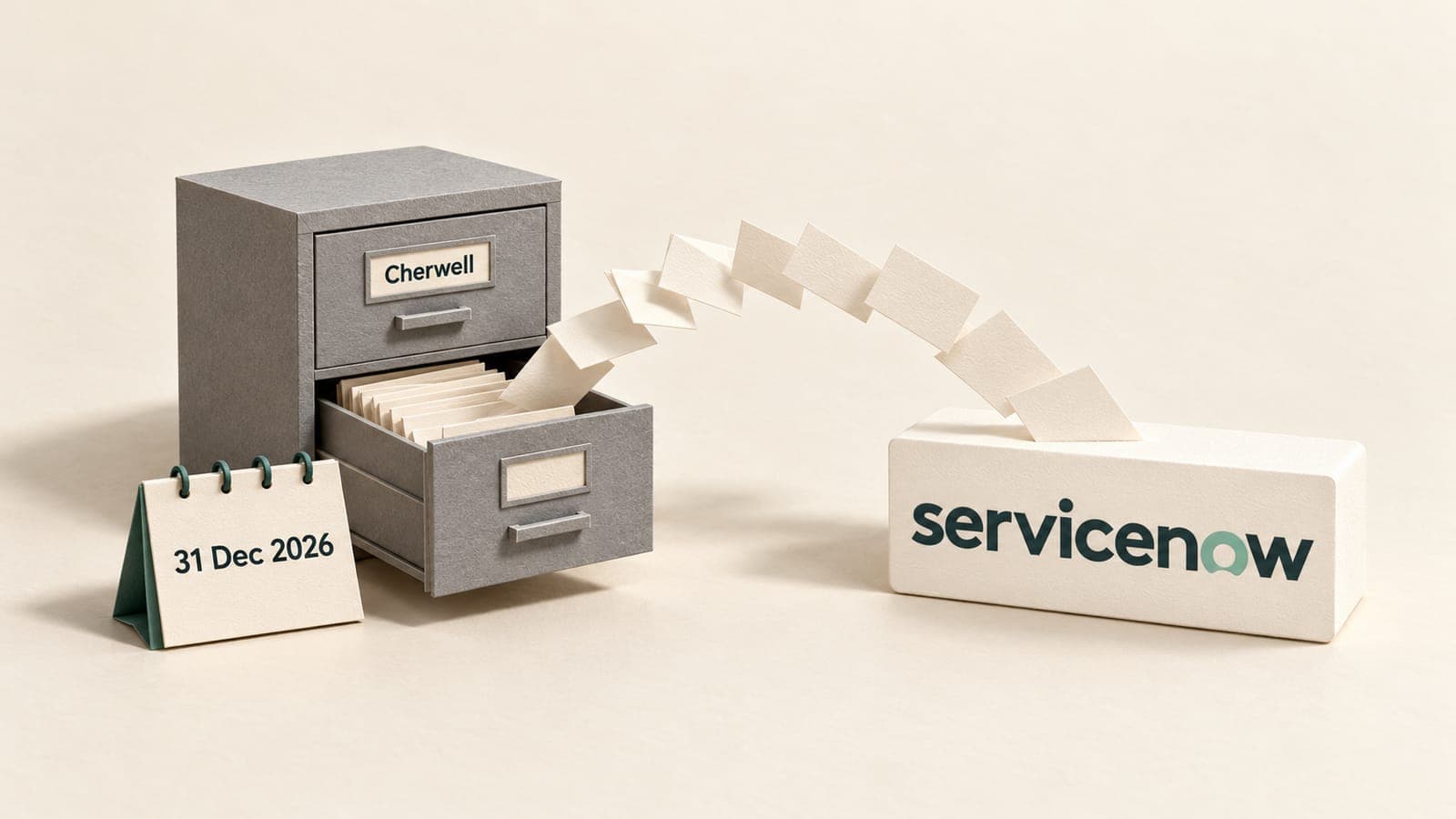
Cherwell Service Management reaches end of life on 31 December 2026, and Ivanti gives 30 December 2026 as the last day of normal licensed access. We move incidents, requests, problems, changes, journals, attachments, CIs and knowledge into ServiceNow, with internal notes and customer updates kept apart and original dates preserved. Our ITSM team runs this route as an engineer-led migration, planned backwards from your cutover date.
- Objects mapped
- 14
- in this route's mapping
- Typical timeline
- About 10-15 business days of migration work, run alongside your ServiceNow build
- 3 phases
- Free sample
- 100 records
- checked by your team first
- Quote
- Fixed
- within 24 hours
What moves
What moves from Cherwell to ServiceNow
Every record type is mapped from Cherwell to its ServiceNow equivalent.
- 15 included
- 1 on request
| Cherwell | maps to | ServiceNow | Status |
|---|---|---|---|
| Objects15 | |||
| Incidents | Incidents (incident) | Included | |
| Service Requests | Requests and Requested Items (sc_request, sc_req_item) | Included | |
| Problems | Problems (problem) | Included | |
| Changes | Change Requests (change_request) | Included | |
| Tasks | Task tables by parent (incident_task, change_task, sc_task) | Included | |
| Customers (Internal and External) and Users | Users (sys_user) | Included | |
| Teams | Assignment Groups (sys_user_group) | Included | |
| Journal - Note | Work notes (internal) | Included | |
| Journal - Customer Request and Mail History | Additional comments or work notes, by agreed rule | Included | |
| Journal - History and SLM History | Read-only reference table (not sys_audit) | Included | |
| Attachments | Attachments (sys_attachment) | Included | |
| Configuration Items and relationships | CMDB classes (cmdb_ci) and cmdb_rel_ci | Included | |
| Knowledge Articles | Knowledge (kb_knowledge) | Included | |
| Service, Category, Subcategory and Specifics | Service, category and subcategory fields | Included | |
| Journal - SLM History and Queue History | Read-only reference tableKept as history linked to each record. Not replayed into sys_audit or task_sla. | Included | |
| Other1 | |||
| Knowledge Article comments | kb_feedback or archiveKnowledge Article journals use Journal - Comment. Agreed per knowledge base whether comments move. | On request | |
CherwellServiceNow
Objects
- IncidentsIncidents (incident)
- Service RequestsRequests and Requested Items (sc_request, sc_req_item)
- ProblemsProblems (problem)
- ChangesChange Requests (change_request)
- TasksTask tables by parent (incident_task, change_task, sc_task)
- Customers (Internal and External) and UsersUsers (sys_user)
- TeamsAssignment Groups (sys_user_group)
- Journal - NoteWork notes (internal)
- Journal - Customer Request and Mail HistoryAdditional comments or work notes, by agreed rule
- Journal - History and SLM HistoryRead-only reference table (not sys_audit)
- AttachmentsAttachments (sys_attachment)
- Configuration Items and relationshipsCMDB classes (cmdb_ci) and cmdb_rel_ci
- Knowledge ArticlesKnowledge (kb_knowledge)
- Service, Category, Subcategory and SpecificsService, category and subcategory fields
- Journal - SLM History and Queue HistoryRead-only reference table
Kept as history linked to each record. Not replayed into sys_audit or task_sla.
Other
- Knowledge Article commentskb_feedback or archive
On request
Knowledge Article journals use Journal - Comment. Agreed per knowledge base whether comments move.
Looking for another object?Field-level mapping is reviewed with you during scoping.
What does not move
What does not move from Cherwell to ServiceNow as-is
These Cherwell items are not migrated as records; each line says what takes their place in ServiceNow.
- One-Step Actions and automation processesNot migrated
- In ServiceNow: Rebuilt as flows and business rules
- Not migrated
- Dashboards and reportsNot migrated
- In ServiceNow: Rebuilt in ServiceNow
- Not migrated
Free sample migration of 100 of your records. Fixed quote within 24 hours.
Scope my migrationTimeline
Cherwell to ServiceNow migration timeline
Estimated total
About 10-15 business days
of migration work, run alongside your ServiceNow build
- MigrateXwe run it
- Youyour team acts
- Bothon a call together
Discovery and mapping
Day 1-5
Access and safety export
You1 dayYou create a Cherwell API client ID and a read-only API user, plus a ServiceNow integration user with import set and attachment rights. You also take a full Cherwell export and store it outside Cherwell.
Schema inventory
MigrateX1-2 daysWe read every business object and its schema through the API, count records per object, status, journal type and attachment type, and list custom objects and fields. Heavily customised tenants take the longer end of this phase.
Scope decision
Both1 dayYou decide what history moves live, what goes to a read-only archive, and what is retired. One-Step Actions and automations are listed as your rebuild backlog.
Mapping sign-off
Both1 dayWe send the mapping sheet: objects to tables, statuses, impact and urgency, Service and Category values, teams to groups, journal routing and CI classes. Your process owners approve or amend it.
Migration
Day 6-11
People, groups and CIs
MigrateX1-2 daysUsers and customers are merged into sys_user, teams become sys_user_group with memberships, then CIs and relationships load into their cmdb_ci classes.
Test migration
Both2 daysA full load into a sub-production ServiceNow instance. Your leads check journals, attachments, dates and CI links on real records.
Production load
MigrateX1-2 daysIncidents, requests, problems, changes, tasks, journals, attachments and knowledge load through import sets in dependency order, with checkpoints by Cherwell record ID.
Delta and cutover
Both0.5-1 dayCherwell is frozen, records changed since the production load are pulled again and re-run on the same coalesce key, and you switch intake to ServiceNow.
Validation
Day 12-15
Reconciliation report
MigrateX1 dayCounts per object, status, group, journal type, attachment and CI class on both sides, plus every record that needed a default or placeholder.
Spot checks
You1-2 daysYour service desk opens a random sample of migrated records, including as a portal-only user, and confirms notes, dates and links.
Fixes and handover
Both1 dayWe fix what the checks raise, re-run the affected batch, and hand over the Cherwell ID to sys_id map and the archive. Cloud customers finish this before their tenant closes.
An estimate. Record volume, API rate limits and how fast your team reviews the sample all move it.
Known risks
Every known risk on this route, with how we handle it
- 2 solved
- 4 handled
- 01HandledMost critical
The deadline is closer than it looks
The problem
Cherwell reaches end of life on 31 December 2026, and 30 December 2026 is the last day of normal licensed access. The data move itself is only part of the work: the ServiceNow instance, its forms, assignment groups, catalog and SLA definitions must exist before records can land in them. Teams that wait for the ServiceNow build to finish before planning the data move run out of calendar.
How we handle it
We run discovery and mapping in parallel with your ServiceNow build, so the data plan is signed off when the instance is ready. The first step, whatever you decide, is a full export of Cherwell kept outside Ivanti's hosting. If cutover cannot land before the date, we move open and recent records first and keep the rest in a read-only archive to load later.
Source: Ivanti Community, checked 15 Nov 2026
- 02HandledMost critical
Every Cherwell tenant has its own schema
The problem
Cherwell lets administrators add fields, forms and whole business objects in a Blueprint, and most tenants have years of changes. Two Cherwell incident tables rarely share the same fields. A fixed field list misses custom objects, custom fields and custom relationships, and nobody notices until a test load is checked.
How we handle it
Discovery starts from the API: we list every business object with getbusinessobjectsummaries, read each schema, count records per object and status, and flag fields that are empty or unused. You then decide per object whether it moves to a standard ServiceNow table, a custom u_ table, or the archive. Nothing is mapped until that inventory is signed.
Source: Ivanti documentation, checked 15 Nov 2026
- 03SolvedMost critical
Internal notes must not reach the portal
The problem
Cherwell splits a record's history into journal types. Journal - Note holds internal analyst notes, while Journal - Customer Request holds what the customer wrote. ServiceNow has two journal fields: work_notes (internal) and comments (customer-visible). Merging the two Cherwell types into one field either hides customer replies or shows internal notes to the caller.
How we handle it
Notes go to work_notes and Customer Request entries go to comments, each written as its own journal entry in original order with the author and time kept. Mail History is routed by direction and agreed with you. We open a sample of migrated records as a portal-only test user before sign-off.
Source: Ivanti documentation, checked 15 Nov 2026
- 04Handled
Cherwell service requests live in the Incident object
The problem
In Cherwell, incidents and service requests are stored together in the Incident business object, and the Service, category and subcategory classification decides which one a record is. In ServiceNow a request is an sc_request with one or more sc_req_item records, each tied to a catalog item, plus sc_task records for fulfilment. There is no catalog item to point historic requests at.
How we handle it
We split Cherwell incidents by classification. Requests become an sc_request with one sc_req_item each, linked to a catalog item you choose or to a single generic historic item. Cherwell Specifics fields are written as labelled values on the item, and Cherwell tasks under the request become sc_task records.
Source: ServiceNow documentation, checked 15 Nov 2026
- 05Handled
CIs and their links load in a fixed order
The problem
Cherwell CI types (such as Computer, Printer and Telephony Equipment, plus any you added) map to different cmdb_ci classes. Relationships between CIs, and links from incidents, problems and changes to CIs, only work if both ends already exist in ServiceNow. Loading CIs outside the identification rules also creates duplicates.
How we handle it
We map each Cherwell CI type to a cmdb_ci class with you, load CIs first with the Cherwell record ID kept as a source key, then load cmdb_rel_ci relationships with an agreed type and direction, and only then attach CIs to tickets. Counts are reconciled per class.
Source: ServiceNow documentation, checked 15 Nov 2026
- 06Solved
Attachments and API pacing
The problem
Cherwell stores imported attachments in its database but can also hold linked files that sit on a network share. ServiceNow takes one file per Attachment API request and applies per-instance rate limit rules that return HTTP 429 when exceeded. A run that ignores either loses files or stalls mid-batch.
How we handle it
We list attachments per record with getbusinessobjectattachments, copy linked files from the share, and count both kinds per record. Uploads are paced against your instance's rate limit rules, honour Retry-After, and checkpoint by Cherwell record ID so an interrupted run resumes without duplicates.
Source: ServiceNow documentation, checked 15 Nov 2026
Technical profile
What makes this route technical
The API limits and data model differences between Cherwell and ServiceNow that shape the plan.
- Cherwell end of life date
- Ivanti's End of Life page lists Cherwell Service Management with an end of life date of 31 December 2026. A CSM licence expires at midnight at the start of its expiry date, so Ivanti gives 30 December 2026 as the last day of normal licensed access.
Source: Ivanti Community, checked 15 Nov 2026
- Cherwell is a discontinued product
- Ivanti lists Cherwell products as "now discontinued" and says Cherwell IT Service Management is available as Ivanti ITSM, part of Ivanti Neurons.
Source: Ivanti website, checked 15 Nov 2026
- What happens after the date
- Ivanti says Cherwell Service Management gets no product updates or official support after 31 December 2026. Ivanti's public pages do not say what happens to Ivanti-hosted tenants or on-premises installs after that date, so confirm it for your contract with your Ivanti account team.
Source: Ivanti Community, checked 15 Nov 2026
- Cherwell REST API authentication
- The API issues a bearer token from POST /token using a password grant with a client ID created in CSM Administrator. Access and refresh token lifetimes come from that client ID's settings, so a long export refreshes its token rather than logging in again.
Source: Ivanti documentation, checked 15 Nov 2026
- How Cherwell data is read
- Records are found with POST /api/V1/getsearchresults (filtered by business object ID) and read in bulk with POST /api/V1/getbusinessobjectbatch. Child records such as journals and tasks come from getrelatedbusinessobject, which pages with pageNumber and pageSize. Files come from getbusinessobjectattachments.
Source: Ivanti documentation, checked 15 Nov 2026
- The schema is read before anything moves
- getbusinessobjectsummaries lists every Major, Supporting, Lookup and Group business object, and getbusinessobjectschema returns each one's fields and relationships. Because every Cherwell tenant is customised, discovery starts from these calls, not from a standard field list.
Source: Ivanti documentation, checked 15 Nov 2026
- Cherwell journal types
- Incidents carry seven default journal types as child records: Note, Customer Request, History, Mail History, SLM History, Queue History and Remote Support History. Each needs its own rule on the ServiceNow side.
Source: Ivanti documentation, checked 15 Nov 2026
- ServiceNow Import Set API
- POST /api/now/import/{stagingTableName} stages each row and runs the transform maps on that staging table synchronously. Transform maps let us coalesce on the Cherwell record ID, so a re-run updates instead of duplicating.
Source: ServiceNow documentation, checked 15 Nov 2026
- ServiceNow attachment ceiling
- The Attachment API uploads one file per request. com.glide.attachment.max_size defaults to 1024 MB per file; allowed types come from glide.attachment.extensions.
Source: ServiceNow documentation, checked 15 Nov 2026
Facts checked 15 Nov 2026 against Ivanti and ServiceNow documentation. Each fact links its source.
Cherwell to ServiceNow questions
Still unsure? Ask the engineer who would run this migration, not a sales rep.
What happens to Cherwell after 31 December 2026?
Ivanti stops product updates and official support for Cherwell Service Management, and 30 December 2026 is the last day of normal licensed access. Ivanti's public pages do not say what happens to hosted tenants or on-premises installs after that, so take a full export before the date and confirm the terms of your contract with your Ivanti account team in writing.
Is there still time?
For the data move, usually yes: the migration itself takes about 10 to 15 business days once ServiceNow is ready to receive records. The tighter constraint is your ServiceNow build and your change freeze. Take a full Cherwell export now, plan discovery alongside the build, and if cutover cannot land before the date, move open and recent records first and archive the rest for a later load.
Should we move to Ivanti Neurons for ITSM instead?
It depends on your needs. Ivanti names Neurons for ITSM as the successor and says many core Cherwell capabilities carry over, and it offers cloud, on-premises and hybrid deployment. It is still a new install, so data has to move either way. ServiceNow suits teams that want ITSM, CMDB and operations on one enterprise platform. Compare both on fit and total cost before deciding.
Our Cherwell is heavily customised. Does that matter?
Yes, it sets the length of discovery. We read every business object and its schema through the Cherwell API before mapping anything, so custom objects and fields are found up front. You then choose per object whether it lands in a standard ServiceNow table, a custom table, or the archive.
How are Cherwell journals handled?
Each journal type gets its own rule. Journal - Note becomes work notes, Journal - Customer Request becomes additional comments, and Mail History follows a rule we agree with you. History and SLM History are kept in a read-only reference table linked to each record, because ServiceNow audit history starts at import.
Will the original created and closed dates be kept?
Yes. Records load through the Import Set API and transform maps, which let us set opened_at, resolved_at and closed_at from Cherwell. A transform script also keeps sys_created_on at the Cherwell value. We check dates on a sample of every object in the test load.
Do One-Step Actions and automations migrate?
No. One-Step Actions, automation processes, SLA definitions, approvals, dashboards and reports are configuration, not data. They are rebuilt in ServiceNow as flows, business rules and reports. We export a list of what you have so it becomes your rebuild backlog.
Are CIs and their relationships included?
Yes. Each Cherwell CI type is mapped to a ServiceNow CMDB class. CIs load first with the Cherwell ID kept as a source key, then relationships, then the links from incidents, problems and changes to CIs. Counts are reconciled per class.
Is there downtime during the migration?
Only a short freeze at cutover. Cherwell stays live during the test and production loads because we only read from it. At cutover you freeze Cherwell, we pull and load anything changed since the production load, and you switch intake to ServiceNow.
What does it cost?
Pricing depends on record volume, the number of business objects in scope, and how much custom mapping your tenant needs. Use the pricing page to get a quote from your counts.
How it compares
Four ways to run Cherwell to ServiceNow
The same data, moved four different ways. This is what changes between them.
Object coverage (incidents, problems, changes, requests, KB)
MigrateX
Every object in the Cherwell connector, plus the ones you ask for during scoping.
Automated migration software
Tickets and contacts are covered. Problems, changes and request items often are not.
Vendor CSV import
One object per file, and only the fields the export template exposes.
In-house scripts
Whatever you have time to build before the cutover date.
Work notes vs comments fidelity
MigrateX
Each entry is posted separately, private stays private, public stays public.
Automated migration software
Threads usually arrive, but per-entry author and visibility can be flattened.
Vendor CSV import
Notes collapse into one field on the ticket, if they come across at all.
In-house scripts
Possible, but it is the part teams most often run out of time for.
Attachments
MigrateX
Uploaded against the right note, and re-hosted with a link when they exceed the ServiceNow cap.
Automated migration software
Supported up to the destination cap. Oversize files are skipped.
Vendor CSV import
Not carried by a CSV import.
In-house scripts
Needs its own download, retry and upload pipeline.
Original IDs cross-referenced
MigrateX
Every source id is stored on the destination record and handed back as a map.
Automated migration software
Often kept as a tag or a single text field.
Vendor CSV import
Lost once the file is imported.
In-house scripts
Only if you design the mapping table up front.
Delta sync before cutover
MigrateX
Included. Anything created or changed during the bulk pass is synced at cutover.
Automated migration software
Usually a paid upgrade on the top tier.
Vendor CSV import
You would re-export and re-import by hand.
In-house scripts
Requires change tracking and idempotent writes on both sides.
Rate-limit handling
MigrateX
Paced to your plan limits, honours Retry-After, and resumes from a checkpoint.
Automated migration software
Backs off, but a long run can still stall and leave partial records.
Vendor CSV import
Not applicable, and the file size limits bite instead.
In-house scripts
The most common reason a home-grown run dies overnight.
Validation report
MigrateX
Counts per object and per status on both sides, with every default and placeholder listed.
Automated migration software
A run log and an error list, rather than a reconciliation.
Vendor CSV import
Row counts in a spreadsheet.
In-house scripts
You write the reconciliation queries yourself.
Rollback plan
MigrateX
Every write is tagged, so a batch can be reversed without touching your own records.
Automated migration software
Some approaches can clear a migration, some cannot.
Vendor CSV import
Manual cleanup of everything the import created.
In-house scripts
Only if you built the tagging in from the start.
Who does the work
MigrateX
A MigrateX engineer runs it and stays on the cutover call.
Automated migration software
You run the software. Support answers tickets.
Vendor CSV import
Your admins, one file at a time.
In-house scripts
Your engineers, instead of your roadmap.
Guides
Guides for a Cherwell to ServiceNow migration



Related routes
Other routes we run



Built for your security review, from the first call.
Read how we handle your dataSOC 2 Type II
Independently audited controls over how we handle your data.
GDPR compliant
Data processing agreement available.
HIPAA compliant
Business associate agreement available.

Start your ServiceNow move with 100 of your records.
Scope my migrationFree sample migration of 100 of your records, plus a fixed quote within 24 hours.