

Methodology: built from vendor pricing pages, product pages and documentation, vendor announcements of the 2026 Gartner Magic Quadrant, and G2 and Capterra review pages, all checked on 1 Oct 2026. No vendor reviewed or paid for this article. We did not run hands-on tests.
The main Jira Service Management alternatives in 2026 are ServiceNow, Freshservice, BMC Helix ITSM, Ivanti Neurons for ITSM, ManageEngine ServiceDesk Plus, SolarWinds Service Desk and HaloITSM, plus Zendesk for support-led teams. The right Jira Service Management alternative depends on your ITIL depth, CMDB and budget, not on a ranking.
You are probably here because JSM Data Center goes read-only on 28 Mar 2029 (Atlassian, as of 1 Oct 2026), or your cloud renewal is about to cost more. This guide compares eight platforms on price, ITIL depth, AI and reviews, then covers what leaving JSM involves.
Key takeaways
- Jira Service Management Data Center becomes read-only on 28 Mar 2029, and existing customers can buy or expand only until 30 Mar 2028 (Atlassian, as of 1 Oct 2026).
- New Atlassian cloud list prices apply to new purchases, renewals and upgrades from 13 Oct 2026 (Atlassian, as of 1 Oct 2026).
- Extra automation steps and Rovo credits above plan allowances are billed from 3 Dec 2026 (Atlassian, as of 1 Oct 2026).
- Atlassian's Jira Cloud backup excludes automation flows, Assets, Opsgenie-powered JSM features and third-party app data (Atlassian, as of 1 Oct 2026). Plan those separately when you leave.
Jira Service Management alternatives at a glance
In short: ServiceNow and BMC Helix suit large ITIL estates, Freshservice, ManageEngine, SolarWinds and HaloITSM publish prices, Ivanti keeps an on-premises option, and Zendesk suits support-led teams. Prices are vendor list prices per agent (or technician) per month; ratings are G2 unless marked.
| Platform | Best fit | Pricing model | Problem, change, CMDB | AI | Rating (reviews) |
|---|---|---|---|---|---|
| Jira Service Management (baseline) | Atlassian shops, dev and ops on one platform | Free to 3 agents; $20 Standard, $51.42 Premium; Enterprise quote | Problem and change from Premium; Assets on paid plans | Rovo credits included per user | 4.3 (986) |
| ServiceNow ITSM | Large enterprises standardizing on one workflow platform | Quote only (Foundation, Advanced, Prime) | CMDB in Foundation; problem and change in Advanced | Now Assist in every package; AI Agents for ITSM in Prime | 4.5 (1,988) |
| Freshservice | Mid-market IT wanting published prices | $19 / $49 / $99, billed annually; Enterprise quote | Problem, change and release from Pro | Freddy AI Copilot add-on, $29 | 4.6 (1,358) |
| BMC Helix ITSM | Large, ITIL-heavy estates and ex-Remedy teams | Quote only | Incident, problem, change and release; CMDB | Agentic AI assistants | 3.7 (297) |
| Ivanti Neurons for ITSM | Teams that need on-premises or hybrid | Quote only | Problem, change and configuration management | Ticket classification, generative AI summaries | 4.0 (294) |
| ManageEngine ServiceDesk Plus | Cost-conscious IT, cloud or on-premises | From $13 / $27 / $67 per technician | Problem and change included in Enterprise, add-ons below | AI in all editions; Zia Agents in Enterprise | 4.2 (251) |
| SolarWinds Service Desk | Mid-size IT wanting change and CMDB on the entry plan | $39 / $99 / $124 per technician, billed annually | Change management and CMDB from Essentials | AI features in Advanced and Premier | 4.3 (787) |
| HaloITSM | Teams that want one license with every module | £66, billed annually, all modules | Problem, change and CMDB included | Halo AI included | Capterra 4.7 (44) |
| Zendesk | Support-led teams, often using JSM for external support | $55 / $115 (Suite Team, Professional), billed annually | Problem and change workflows; asset management | AI agents; Copilot add-on, $50 | 4.3 (7,086) |
All prices, plan features and ratings as of 1 Oct 2026, from the linked vendor, G2 and Capterra pages. HaloITSM uses Capterra because its G2 page has fewer than 50 reviews.
Why teams look for a Jira Service Management alternative in 2026
Most teams shortlisting JSM competitors this year are reacting to dated Atlassian changes, not a missing feature. JSM itself is well placed: Atlassian, ServiceNow, Freshworks and BMC Helix each announced a Leader placement in the 2026 Gartner Magic Quadrant for IT Service Management Platforms (Atlassian, ServiceNow, Freshworks, BMC Helix, as of 1 Oct 2026).
| Date | What changes | Source |
|---|---|---|
| 30 Mar 2026 | New customers can no longer buy Data Center subscriptions | Atlassian, as of 1 Oct 2026 |
| 13 Oct 2026 | New cloud list prices for new purchases, renewals and upgrades; quotes issued earlier are honored until they expire | Atlassian, as of 1 Oct 2026 |
| 3 Dec 2026 | Extra automation steps billed at $0.50 per 1,000, and extra Rovo credits at $0.01 each | Atlassian automation, Atlassian Rovo, as of 1 Oct 2026 |
| 5 Apr 2027 | Opsgenie shuts down; its alerting and on-call features now sit in JSM | Atlassian, as of 1 Oct 2026 |
| 30 Mar 2028 | Last date for existing Data Center customers to buy or expand | Atlassian, as of 1 Oct 2026 |
| 28 Mar 2029 | Data Center subscriptions, including JSM, expire and turn read-only | Atlassian, as of 1 Oct 2026 |
Atlassian's FAQ does not publish the size of the October increase. Eficode, an Atlassian partner, reports 7.5% for Service Collection Standard and Premium and 10% for Enterprise (Eficode, as of 1 Oct 2026).
Packaging matters too. Problem and change management moved out of Free and Standard into Premium and Enterprise in October 2024 (Atlassian, as of 1 Oct 2026), and JSM is now sold only inside the cloud Service Collection (Atlassian, as of 1 Oct 2026). If you are searching for Jira Service Desk alternatives, it is the same product: Atlassian called JSM "the next generation of Jira Service Desk" (Atlassian, as of 1 Oct 2026).
On G2, a steep learning curve is the most-cited JSM drawback (G2, as of 1 Oct 2026). For the full date-by-date picture, read our Jira Data Center end-of-life timeline; for every usage meter, see the Jira Service Management pricing breakdown.
The 8 Jira Service Management competitors, compared
Each card uses the same fields. The other 2026 Magic Quadrant Leaders come first; the order is not a ranking.
1. ServiceNow ITSM
Best for: large enterprises that want ITSM, operations and employee workflows on one platform.
Pricing: quote only, for ITSM Foundation, Advanced and Prime.
ITIL depth: CMDB sits in Foundation; Problem, Change and Major Incident Management start at Advanced (ServiceNow, as of 1 Oct 2026).
AI: Now Assist is in every package; the L1 Service Desk AI Specialist and AI Agents for ITSM are listed in Prime.
Reviews: 4.5/5 from 1,988 G2 reviews (G2, as of 1 Oct 2026).
Leaving JSM for it: request types become catalog items and Assets objects map to CMDB classes; see our ServiceNow vs Jira Service Management comparison.
2. Freshservice
Best for: mid-market IT teams that want published pricing and a fast rollout.
Pricing: Starter $19, Growth $49 and Pro $99 per agent per month, billed annually; Enterprise by quote (Freshworks, as of 1 Oct 2026).
ITIL depth: problem, change and release management start at Pro.
AI: Freddy AI Copilot is a $29 per agent add-on (Freshworks, as of 1 Oct 2026).
Reviews: 4.6/5 from 1,358 G2 reviews (G2, as of 1 Oct 2026).
Leaving JSM for it: JSM Premium teams running problem and change should price Pro. See Freshservice vs ServiceNow if both are shortlisted.
3. BMC Helix ITSM
Best for: large organizations with deep ITIL processes, and teams coming from BMC Remedy.
Pricing: quote only, via "Request Pricing".
ITIL depth: BMC lists incident, problem, change and release, and service level management, plus a CMDB (BMC Helix, as of 1 Oct 2026).
AI: BMC describes agentic AI assistants that surface risks and draft resolution content.
Reviews: 3.7/5 from 297 G2 reviews (G2, as of 1 Oct 2026).
Leaving JSM for it: JSM work items map into separate ITIL record types, so plan state and priority mapping early. Our ServiceNow vs BMC Helix comparison explains the Helix model.
4. Ivanti Neurons for ITSM
Best for: Data Center teams that still need an on-premises or hybrid deployment.
Pricing: quote only; not published on the product page.
ITIL depth: 14 ITIL 4-certified practices, including problem, change and configuration management, deployable "in the cloud, on-premises, or through a hybrid setup" (Ivanti, as of 1 Oct 2026).
AI: ticket classification, AI-written knowledge articles and generative AI summaries.
Reviews: 4.0/5 from 294 G2 reviews (G2, as of 1 Oct 2026).
Leaving JSM for it: keeps data in your own environment, the usual reason Data Center was chosen. Budget for configuration time.
5. ManageEngine ServiceDesk Plus
Best for: cost-conscious IT teams that want cloud or on-premises.
Pricing: from $13 (Standard), $27 (Professional) and $67 (Enterprise) per technician per month, with Standard free for up to five technicians (ManageEngine, as of 1 Oct 2026).
ITIL depth: problem, change and release management are included in Enterprise and sold as add-ons below it; CMDB is an add-on in Professional.
AI: included in all editions at no extra cost; Zia Agents in Enterprise.
Reviews: 4.2/5 from 251 G2 reviews (G2, as of 1 Oct 2026).
Leaving JSM for it: compare Enterprise, not Standard, with JSM Premium.
6. SolarWinds Service Desk
Best for: mid-size IT teams that want change management and a CMDB on the entry plan.
Pricing: Essentials $39, Advanced $99 and Premier $124 per technician per month, billed annually (SolarWinds, as of 1 Oct 2026).
ITIL depth: Essentials lists change management, a CMDB, asset management and SLAs. The pricing page does not place problem management in a plan, so confirm it.
AI: a virtual agent from Advanced; AI incident summaries and incident-to-problem linking in Premier.
Reviews: 4.3/5 from 787 G2 reviews (G2, as of 1 Oct 2026).
Leaving JSM for it: API access is listed from Advanced, which matters for loading history.
7. HaloITSM
Best for: teams tired of tier-by-tier feature gating.
Pricing: £66 per agent per month, billed annually, with "no tiers, no bolt-ons"; end users are free (Halo, as of 1 Oct 2026).
ITIL depth: incidents, service requests, change, problem and major incidents, plus CMDB, are included as standard.
AI: Halo AI is part of the standard license.
Reviews: 4.7/5 from 44 Capterra reviews (Capterra, as of 1 Oct 2026), a small sample.
Leaving JSM for it: problem and change history has a target without a plan upgrade. Plan who rebuilds reports.
8. Zendesk (for support-led teams)
Best for: teams that use JSM mainly for external customer support.
Pricing: Suite Team $55 and Suite Professional $115 per agent per month, billed annually; Copilot is a $50 add-on (Zendesk, as of 1 Oct 2026).
ITIL depth: Zendesk's ITSM page lists change approvals, problem handling and asset management, but no CMDB (Zendesk, as of 1 Oct 2026).
AI: AI agents across channels.
Reviews: 4.3/5 from 7,086 G2 reviews for Zendesk for Customer Service (G2, as of 1 Oct 2026).
Leaving JSM for it: fits customer service more than IT teams with CAB approvals and CIs; see Zendesk vs Freshservice.
How to choose a Jira Service Management alternative
Choose on the cost of change, not the per-agent price. Five questions narrow the shortlist:
- Which ITIL processes do you run today, and at which tier will the target include them? JSM gates problem and change at Premium; most alternatives gate them too.
- How big is your CMDB? Count Assets objects and relationship types, and check where the target's CMDB starts.
- Do you need on-premises or hybrid? If Data Center was a compliance choice, only some alternatives keep that option.
- What will you rebuild? Count automation rules, SLA goals, request types and Marketplace apps.
- How much history must stay usable? Audit, reporting and AI tools depend on it.
For a wider shortlist, start with our top ITSM tools in 2026, or read what ITSM software is and how to choose it. If ServiceNow is the platform you are leaving instead, see the ServiceNow alternatives list.
What switching off Jira Service Management takes
Leaving JSM is a platform migration, not an export. Atlassian's Jira Cloud Migration Assistant handles "migrations from Server or Data Center to Cloud" (Atlassian, as of 1 Oct 2026), not moves to another vendor. Records move as data; workflows, automations, business rules, SLA definitions, macros and running SLA timers are rebuilt on the target.
What you can get out of JSM
Each Atlassian export route leaves something out. Map the gaps before you choose a load method.
| Export route | What Atlassian documents | What to plan for |
|---|---|---|
| Jira Cloud backup | Excludes automation flows, third-party apps and data, Opsgenie-powered JSM features and Assets (Atlassian, as of 1 Oct 2026) | Export rules, Assets and alert history separately |
| CSV export from search | Up to 10,000 work items per export; split larger sets by project, date or status (Atlassian, as of 1 Oct 2026) | Reconcile counts across every batch |
| Assets object export | CSV per object type, filtered by AQL; a "data consistent" format keeps references for re-import (Atlassian, as of 1 Oct 2026) | Rebuild ticket-to-CI links on the target |
| Assets schema export (Data Center) | Excludes object history and comments, automation and import configurations, and connected Jira tickets (Atlassian, as of 1 Oct 2026) | Extract object history another way if auditors need it |
| Knowledge base (Confluence) | Spaces export to Word, PDF, CSV, HTML or XML (Atlassian, as of 1 Oct 2026) | Article links in requests change on the target |
| SLA data | JSM Cloud displays remaining time; Atlassian's workaround copies elapsed time into a field with automation so it can be exported to CSV (Atlassian, as of 1 Oct 2026) | Capture SLA outcomes before you freeze the source |
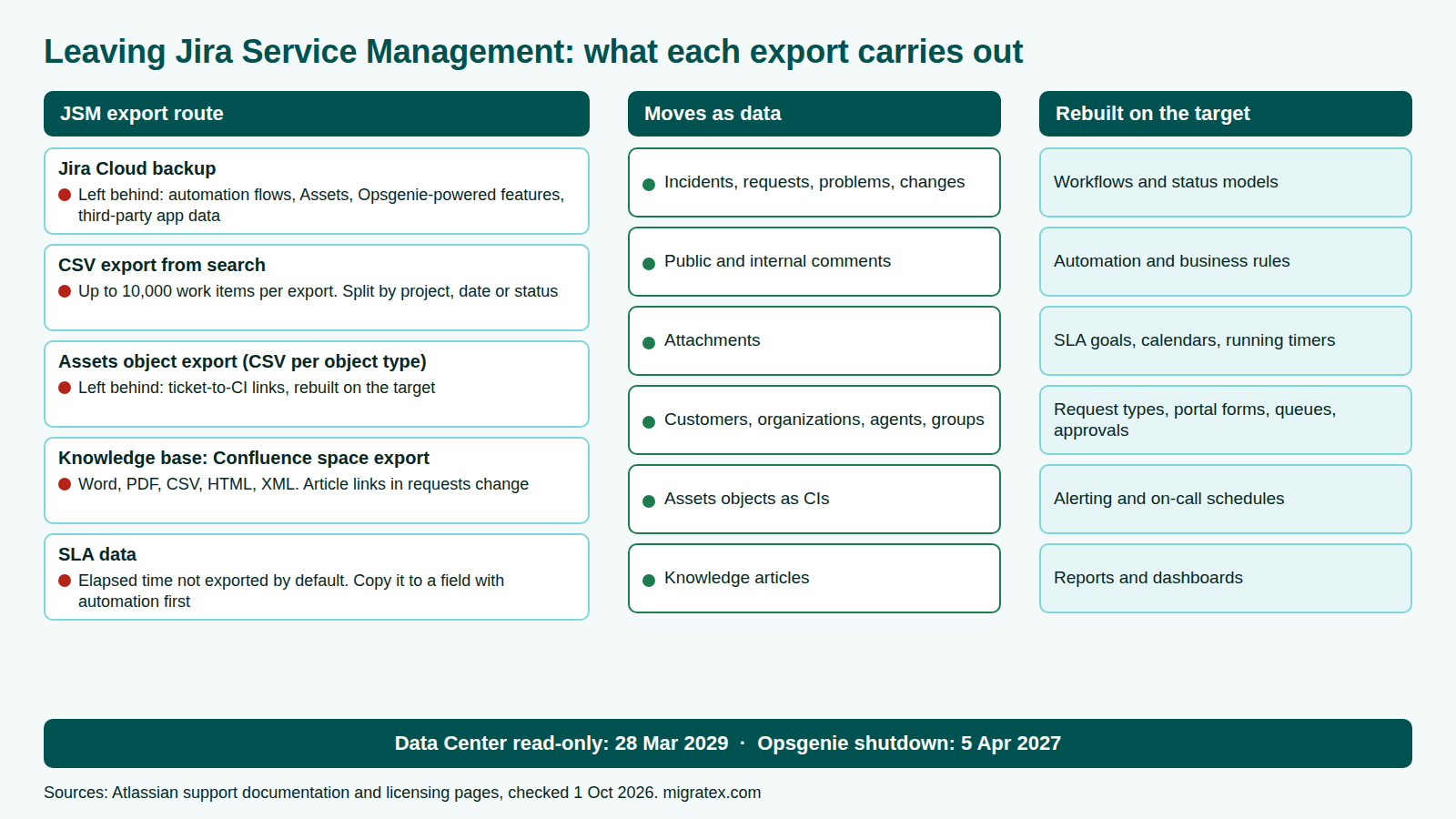
What moves, what gets rebuilt, what's at risk
| What moves (as data) | What gets rebuilt (not migrated) | What's at risk |
|---|---|---|
| Incidents, requests, problems and changes, with status and dates | Workflows and status models | Internal comments turning public if visibility isn't mapped |
| Public and internal comments, with author and timestamp | Automation rules and business rules | SLA history, since elapsed time isn't exported by default |
| Attachments | SLA goals, calendars and running timers | Links between incidents, problems, changes and CIs |
| Customers, organizations, agents and groups | Request types, portal forms, queues and approvals | Alert and on-call history from Opsgenie-powered features |
| Assets objects and attributes, as CIs | Opsgenie-era alerting and on-call schedules | Marketplace app data left out of backups |
| Knowledge articles | Reports and dashboards | Ticket-to-article links |
The reverse direction follows the same rule; our ServiceNow to Jira migration guide shows it from the Atlassian side. The phases (discover, map, test migration, cutover with delta sync, reconcile, hypercare) are in our ITSM migration guide, and the ITSM migration checklist covers scoping.
Jira Service Management switching checklist
- Note your renewal date and whether your quote predates the 13 Oct 2026 price change (Atlassian, as of 1 Oct 2026).
- If you run Data Center, fix your cutover before the 28 Mar 2029 read-only date (Atlassian, as of 1 Oct 2026).
- List the ITIL processes you run and the tier each target needs for them.
- Count Assets objects, object types and relationship types.
- List automation rules, SLA goals, request types, queues, Marketplace apps and Opsgenie-powered features to rebuild.
- Capture SLA elapsed time and outcomes as fields before export.
- Plan CSV exports in batches under 10,000 work items (Atlassian, as of 1 Oct 2026), or use the API.
- Export Assets and the Confluence knowledge base separately from the Jira backup.
- Map internal and public comments and prove the split in a test migration.
- Agree the history scope, then reconcile counts per object and status before go/no-go.
FAQ
Methodology
We compared eight platforms using vendor pricing and product pages, vendor announcements of the 2026 Gartner Magic Quadrant, and G2 reviews (Capterra where G2 has fewer than 50), all checked on 1 Oct 2026. Atlassian facts come from Atlassian's licensing pages and documentation. We read ranking pages for gaps but do not cite them. The order is not a ranking, and we ran no hands-on tests.
Disclosure: MigrateX, the publisher of this article, runs ITSM data migrations, including between platforms named here. No vendor reviewed or paid for this article.