



 GDPR compliant
 HIPAA compliant
HaloITSMFreshservice
HaloITSM to Freshservice migration
ITSM specialists move your clients, tickets and problems into Freshservice, check a sample with you first, and count every record on both sides.
Scope my migration
Free sample migration of 100 of your records, plus a fixed quote within 24 hours.
Last updated October 2026 · 9 object types mapped
- 1000+migrations
- 15 yearsof collective experience
 SOC 2 Type IIGDPR compliantHIPAA compliant
HaloITSM to Freshservice at a glance
We move tickets, problems, changes, users, clients, agents and your knowledge base from HaloITSM into Freshservice, with each ticket's actions kept as ordered public and private notes. An engineer maps ticket types, statuses, clients and custom fields with you, imports in dependency order, and reconciles counts on both sides before you cut over.
- Objects mapped
- 9
- from the live connector
- Typical timeline
- About 10 business days for up to 100k records
- 3 phases
- Free sample
- 100 records
- checked by your team first
- Quote
- Fixed
- within 24 hours
What moves
What moves from HaloITSM to Freshservice
Every object our connector moves, in the order it is written into Freshservice.
- 11 included
- 2 on request
| HaloITSM | maps to | Freshservice | Status | Order | Migrated after |
|---|---|---|---|---|---|
| Tickets8 | |||||
| Agents | Agents | Included | 1 | - | |
| Clients | Departments | Included | 2 | - | |
| Users | Requesters | Included | 3 | - | |
| Tickets | Tickets | Included | 4 | - | |
| Problems | Problems | Included | 5 | - | |
| Change Requests | Changes | Included | 6 | - | |
| Actions | Public and Private NotesRead per ticket in order. Emails and visible notes become public notes, hidden actions become private notes. | Included | - | - | |
| Attachments | AttachmentsUploaded to the matching note. Files over the 40 MB per-ticket cap are re-hosted and linked. | Included | - | - | |
| Knowledge Base3 | |||||
| FAQ Lists | Categories | Included | 7 | - | |
| FAQ Sub-lists | Folders | Included | 8 | - | |
| Articles | Articles | Included | 9 | - | |
| Other2 | |||||
| Sites | LocationsEach Halo site becomes a Freshservice location, linked to its requesters. | On request | - | - | |
| Teams | Agent GroupsHalo teams with their agent members. Needed so tickets keep their assigned team. | On request | - | - | |
HaloITSMFreshservice
Tickets
- AgentsAgents
Order 1
- ClientsDepartments
Order 2
- UsersRequesters
Order 3
- TicketsTickets
Order 4
- ProblemsProblems
Order 5
- Change RequestsChanges
Order 6
- ActionsPublic and Private Notes
Read per ticket in order. Emails and visible notes become public notes, hidden actions become private notes.
- AttachmentsAttachments
Uploaded to the matching note. Files over the 40 MB per-ticket cap are re-hosted and linked.
Knowledge Base
- FAQ ListsCategories
Order 7
- FAQ Sub-listsFolders
Order 8
- ArticlesArticles
Order 9
Other
- SitesLocations
On request
Each Halo site becomes a Freshservice location, linked to its requesters.
- TeamsAgent Groups
On request
Halo teams with their agent members. Needed so tickets keep their assigned team.
Looking for another object?From the MigrateX connector catalogue, fetched 22 Sep 2026. Object mapping is live in our connectors; field-level mapping is reviewed with you during scoping.
Free sample migration of 100 of your records. Fixed quote within 24 hours.
Scope my migrationTimeline
HaloITSM to Freshservice migration timeline
Estimated total
About 10 business days
for up to 100k records
- MigrateXwe run it
- Youyour team acts
- Bothon a call together
Preparation
Day 1-2
Access and scope
You1 dayYou create a Halo API application with a client ID and secret, impersonating an agent who can read tickets, actions, users and the knowledge base, plus a Freshservice API key. We agree which ticket types, clients, date ranges and FAQ lists are in scope.
Schema and volume export
MigrateX0.5 dayWe pull record counts, ticket types and their field lists, statuses, teams, clients, sites and attachment sizes from Halo, and the current setup from Freshservice.
Mapping sign-off
Both0.5 dayWe send the mapping sheet: clients to departments, sites to locations, statuses, priorities, teams and every custom field. You approve or amend it.
Migration
Day 3-7
People and structure
MigrateX1 dayDepartments, locations, requesters, agents and groups are created in Freshservice in dependency order. Custom fields are added for the Halo ticket ID and original dates.
Sample run
Both1 dayA few hundred tickets across your main ticket types, with actions and attachments, so you can check the result before the bulk pass.
Bulk pass
MigrateX2-3 daysTickets, problems, changes, notes and attachments in batches, paced to Halo's 5-minute window and the Freshservice plan limit, with checkpoints by Halo ticket ID. FAQ lists and articles follow.
Delta and cutover
Both0.5 dayTickets created or updated in Halo since the bulk pass are synced. You switch your mailboxes and portal to Freshservice; Halo becomes read-only.
Validation
Day 8-10
Reconciliation report
MigrateX1 dayCounts per object, ticket type, status and client on both sides, plus every record that needed a placeholder or default mapping.
Spot checks
You1 dayYour service desk leads open a random sample of migrated tickets and articles and confirm notes, attachments, requesters and departments are right.
Fixes and sign-off
Both1 dayWe correct anything the spot checks raise, re-run the affected batch, and hand over the id map and mapping sheet.
An estimate. Record volume, API rate limits and how fast your team reviews the sample all move it.
Known risks
Every known risk on this route, with how we handle it
- 3 solved
- 4 handled
- 01SolvedMost critical
Actions mix emails, notes and system events in one log
The problem
Every Halo ticket holds an ordered list of actions: emails to the user, private notes, status changes and system-generated entries. Some are hidden from the user, some are not. An export that only reads the ticket record loses the whole conversation, and one that copies every action unfiltered fills Freshservice with status-change noise.
How we handle it
We read actions per ticket in order and classify each one. Emails and user-visible notes become public notes, hidden actions become private notes, and pure system actions are summarised in one private note or dropped, as you choose. The original author and time are written at the top of each note because Freshservice documents no way to backdate it.
Source: Halo guides, checked 15 Nov 2026
- 02Handled
Each Halo ticket type has its own field list
The problem
In Halo, custom fields are attached to ticket types, so an incident, a service request and a change can each carry different fields. Fields with the same label on different Halo types may hold different values.
How we handle it
We export the field list for every ticket type in scope, merge fields that mean the same thing, and create the rest as Freshservice custom fields with the source type noted. Selection fields keep their option lists. The mapping sheet shows every Halo field and where it lands before you approve the run.
Source: Halo guides, checked 15 Nov 2026
- 03SolvedMost critical
Halo's API window sets the pace of the export
The problem
Halo allows 700 API requests in a rolling 5-minute window. Tickets can be listed in pages, but actions and attachments are usually fetched per ticket, so a 100k-ticket tenant needs far more requests than the ticket count suggests. An export that ignores the window stalls on HTTP 429.
How we handle it
The runner paces reads against the 5-minute window, backs off on 429, and checkpoints by Halo ticket ID so an interrupted batch resumes without duplicates. We start the export early in the project so the read side is finished before the bulk write to Freshservice begins.
Source: Halo guides, checked 15 Nov 2026
- 04Handled
Freshservice documents no way to backdate tickets or notes
The problem
Freshservice does not document a way to set the original created date on a ticket. A ticket created today shows today's date, which breaks age reports and SLA history for migrated Halo tickets.
How we handle it
We add date custom fields for the original date logged, date responded and date closed, and fill them from Halo. Closed tickets are imported in their final state so no SLA timer starts in Freshservice.
Source: Freshservice API documentation, checked 15 Nov 2026
- 05Handled
Halo statuses and SLA holds do not line up
The problem
Halo lets you define as many statuses as you need, and some, like With User, pause the SLA timer. Freshservice tickets have four built-in statuses: Open, Pending, Resolved and Closed. Response and resolution targets from Halo SLA plans do not carry over as data.
How we handle it
We agree a status mapping before the first run, for example With User to Pending and Cancelled to Closed with a tag. Halo SLA plans are listed in the mapping sheet so your admin can rebuild them as Freshservice SLA policies. Whether each Halo ticket met or missed its target is kept in a custom field.
Source: Halo guides, checked 15 Nov 2026
- 06Solved
Requesters and departments must exist before tickets
The problem
A Freshservice ticket needs a requester. If a ticket is created with an unknown email, Freshservice adds a new contact for that email, with no department or location. Halo users who have left, or were created from a one-off email, still appear on old tickets.
How we handle it
We import in dependency order: clients to departments, sites to locations, users to requesters, then agents and teams, and only then tickets. Inactive Halo users who still appear on tickets get a placeholder requester so the ticket keeps its history.
Source: Freshservice API documentation, checked 15 Nov 2026
- 07Handled
Large attachments hit the 40 MB per-ticket cap
The problem
Freshservice caps the combined attachments on a ticket at 40 MB across the description and every note. Long Halo tickets with screenshots, logs and email attachments on many actions can pass that total.
How we handle it
We size every attachment during export. Files that fit are uploaded to the matching note. Anything over the cap is stored in your own storage and linked in the note where it sat, with the original filename and size.
Source: Freshservice API documentation, checked 15 Nov 2026
Technical profile
What makes this route technical
The API limits and data model differences between HaloITSM and Freshservice that shape the plan.
- Halo API rate limit
- 700 API requests in any rolling 5-minute window, about 140 per minute on average. Going over returns HTTP 429. The limit is set in Halo's fair use policy, which covers HaloITSM.
Source: Halo guides, checked 15 Nov 2026
- Halo API access
- You create an API application under Configuration > Integrations > Halo API. The usual method is a client ID and secret, and the application must impersonate an agent. That agent's permissions limit what the export can read.
Source: Halo guides, checked 15 Nov 2026
- Ticket history lives in Actions
- All work on a Halo ticket is recorded as actions: emails to the user, private notes, status changes and system actions. Private notes are hidden from the user by default. Actions are read separately from the ticket record.
Source: Halo guides, checked 15 Nov 2026
- Halo customer hierarchy
- Halo organises end users as clients, then sites, then users, and Top Levels optionally group clients. A site is a location under a client, and every user belongs to a client and a site.
Source: Halo guides, checked 15 Nov 2026
- Freshservice API rate limit (Pro plan)
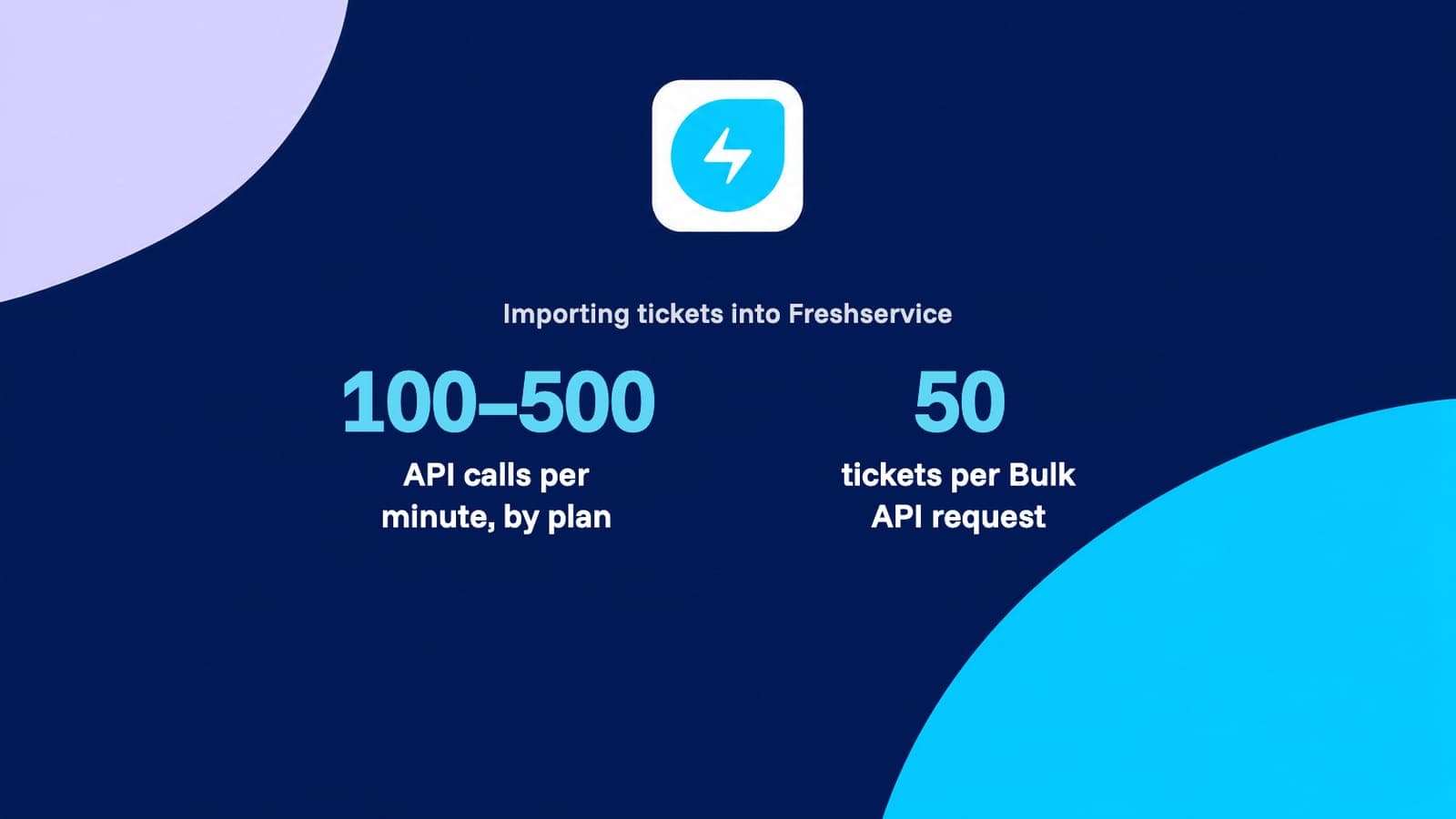
- 400 requests per minute overall on Pro (Starter 100, Growth 200, Enterprise 500), with a sub-limit of 140 ticket creates per minute on Pro. Invalid requests count too, and HTTP 429 comes back with a Retry-After header.
Source: Freshservice API documentation, checked 15 Nov 2026
- Freshservice attachment cap per ticket
- The total size of all attachments on a ticket, across the description and every note, cannot exceed 40 MB.
Source: Freshservice API documentation, checked 15 Nov 2026
- Historical timestamps
- Freshservice does not document a way to set the original created date on a ticket or note. The original Halo date logged and date closed are kept in dedicated custom fields.
Source: Freshservice API documentation, checked 15 Nov 2026
Facts checked 15 Nov 2026 against Halo and Freshservice documentation. Each fact links its source.
Testimonials
What our customers say
“We've done ServiceNow to Freshservice, HaloITSM to Freshservice, even a Freshservice to JSM move. Honestly I was nervous about the ServiceNow one because of the dataset size. But it just... worked. No drama.”

Charles Manuel
CEO, FreshIdeas.ai
HaloITSM to Freshservice questions
Still unsure? Ask the engineer who would run this migration, not a sales rep.
Do HaloITSM tickets keep their full conversation?
Yes. We read every action on each ticket in order. Emails and user-visible notes become public notes, and hidden actions become private notes. The original author and time are written at the top of each note.
What happens to Halo clients and sites?
By default each client becomes a Freshservice department and each site becomes a location, and users are linked to both. If you run Halo for several outside customers, we agree a different model with you first, because Freshservice is built around one organisation.
Our ticket types each have different fields. How are they handled?
We export the field list for every ticket type in scope, merge fields that mean the same thing, and create the rest as Freshservice custom fields. The mapping sheet shows where every Halo field lands before you approve the run.
Are system actions like status changes migrated?
You choose. We can summarise system actions in one private note per ticket, or leave them out so agents only see real messages and notes. Most teams keep the summary for audit purposes.
Will the original dates be preserved?
Not in the built-in timestamp fields, because Freshservice does not document a way to set the original created date. We create date custom fields for the original date logged and date closed and fill them from Halo, so reports can be rebuilt against those fields.
Do our SLA plans come across?
Not as working policies. Halo SLA plans are listed in the mapping sheet so your admin can set them up as Freshservice SLA policies. Closed tickets are imported in their final state so no timers start, and whether each ticket met its target is kept in a custom field.
Are assets and the knowledge base included?
FAQ lists, sub-lists and articles are in the standard scope and become Freshservice categories, folders and articles. Assets are available on request and map Halo asset types to Freshservice asset types.
Is there downtime during the migration?
No. Halo stays live during the bulk pass because we only read from it. At cutover we sync anything created or changed since the bulk run, you switch your mailboxes and portal to Freshservice, and Halo becomes read-only.
What does it cost?
Pricing depends on record volume, the number of objects in scope and how much custom mapping is needed. Use the pricing page to get a quote from your counts; there is no per-record charge for notes or attachments.
How long does it take?
About ten business days for up to 100k records: two for preparation and mapping sign-off, five for the sample run, bulk pass and delta, and three for validation. Large tenants take longer mostly because Halo limits API requests per 5-minute window.
How it compares
Four ways to run HaloITSM to Freshservice
The same data, moved four different ways. This is what changes between them.
Object coverage (incidents, problems, changes, requests, KB)
MigrateX
Every object in the HaloITSM connector, plus the ones you ask for during scoping.
Automated migration software
Tickets and contacts are covered. Problems, changes and request items often are not.
Vendor CSV import
One object per file, and only the fields the export template exposes.
In-house scripts
Whatever you have time to build before the cutover date.
Work notes vs comments fidelity
MigrateX
Each entry is posted separately, private stays private, public stays public.
Automated migration software
Threads usually arrive, but per-entry author and visibility can be flattened.
Vendor CSV import
Notes collapse into one field on the ticket, if they come across at all.
In-house scripts
Possible, but it is the part teams most often run out of time for.
Attachments
MigrateX
Uploaded against the right note, and re-hosted with a link when they exceed the Freshservice cap.
Automated migration software
Supported up to the destination cap. Oversize files are skipped.
Vendor CSV import
Not carried by a CSV import.
In-house scripts
Needs its own download, retry and upload pipeline.
Original IDs cross-referenced
MigrateX
Every source id is stored on the destination record and handed back as a map.
Automated migration software
Often kept as a tag or a single text field.
Vendor CSV import
Lost once the file is imported.
In-house scripts
Only if you design the mapping table up front.
Delta sync before cutover
MigrateX
Included. Anything created or changed during the bulk pass is synced at cutover.
Automated migration software
Usually a paid upgrade on the top tier.
Vendor CSV import
You would re-export and re-import by hand.
In-house scripts
Requires change tracking and idempotent writes on both sides.
Rate-limit handling
MigrateX
Paced to your plan limits, honours Retry-After, and resumes from a checkpoint.
Automated migration software
Backs off, but a long run can still stall and leave partial records.
Vendor CSV import
Not applicable, and the file size limits bite instead.
In-house scripts
The most common reason a home-grown run dies overnight.
Validation report
MigrateX
Counts per object and per status on both sides, with every default and placeholder listed.
Automated migration software
A run log and an error list, rather than a reconciliation.
Vendor CSV import
Row counts in a spreadsheet.
In-house scripts
You write the reconciliation queries yourself.
Rollback plan
MigrateX
Every write is tagged, so a batch can be reversed without touching your own records.
Automated migration software
Some approaches can clear a migration, some cannot.
Vendor CSV import
Manual cleanup of everything the import created.
In-house scripts
Only if you built the tagging in from the start.
Who does the work
MigrateX
A MigrateX engineer runs it and stays on the cutover call.
Automated migration software
You run the software. Support answers tickets.
Vendor CSV import
Your admins, one file at a time.
In-house scripts
Your engineers, instead of your roadmap.
Guides
Guides for a HaloITSM to Freshservice migration

Related routes
Other routes we run




Built for your security review, from the first call.
Read how we handle your dataSOC 2 Type II
Independently audited controls over how we handle your data.
GDPR compliant
Data processing agreement available.
HIPAA compliant
Business associate agreement available.

Start your Freshservice move with 100 of your records.
Scope my migrationFree sample migration of 100 of your records, plus a fixed quote within 24 hours.