10 Best AI Helpdesk Software for B2B: Which Are AI-Native? (2026)
10 AI helpdesks for B2B scored on an AI-native test, with dated G2 ratings, seat prices, AI pricing per resolution or credit, and what moving in involves.
 Ayush BothraFounding Member, MigrateX
Published 30 min read
On this page
- AI helpdesk software compared: 2026 table
- What is an AI-native helpdesk?
- What changed in AI helpdesks in 2026
- How to choose an AI helpdesk for B2B
- The 10 best AI helpdesk software platforms, reviewed
- How AI pricing works across these platforms
- Why your ticket history decides how good the AI is
- Best AI helpdesk for B2B account management
- Best AI helpdesk by team size
- Best AI helpdesk software by use case
- How to switch without losing history
- AI helpdesk software FAQ
- Move your history into the AI helpdesk you pick
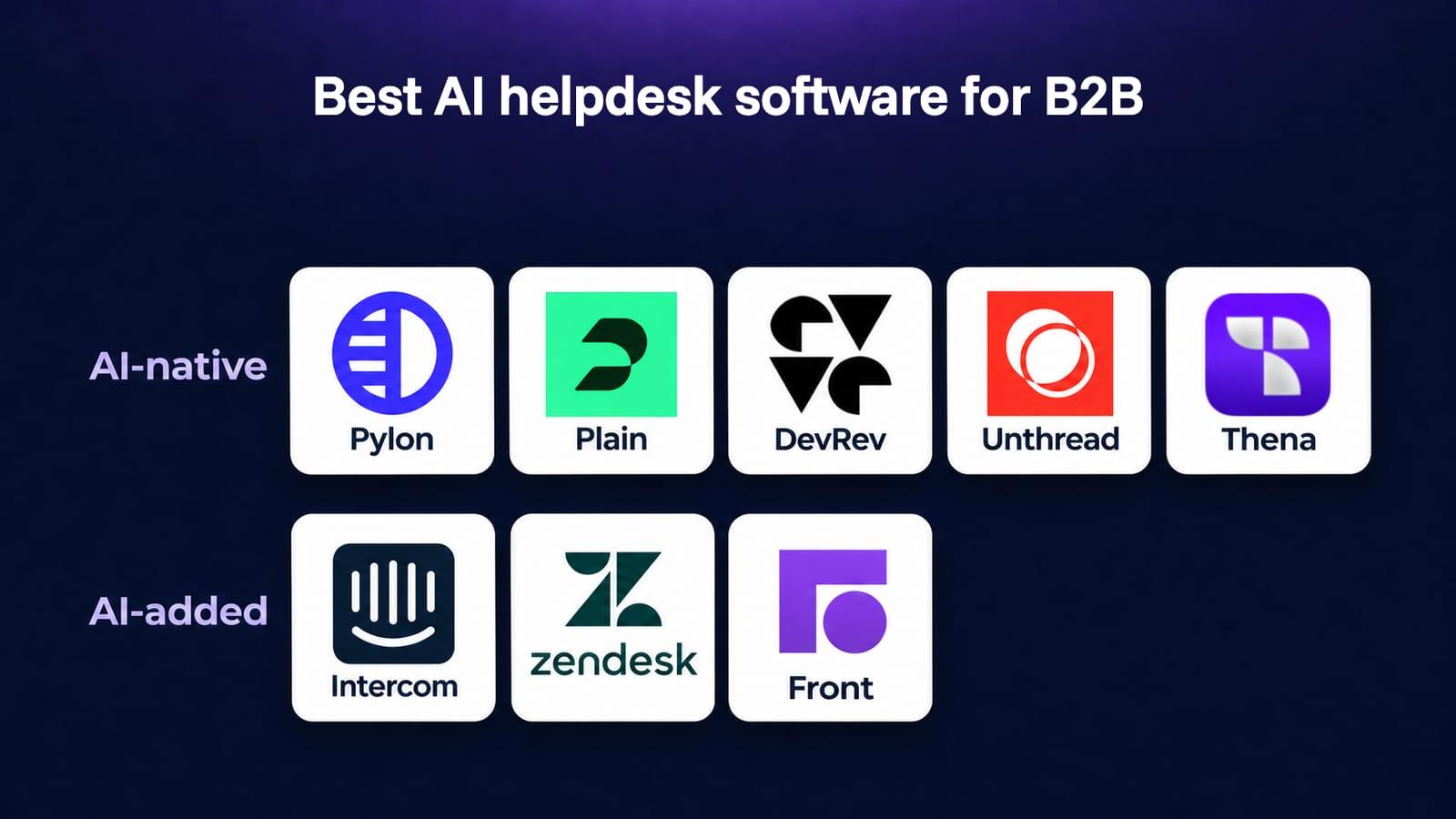
The best AI helpdesk software for B2B in 2026 splits into two groups: AI-native platforms built around AI agents and customer accounts (Pylon, Plain, DevRev, Thena and Unthread, plus Atlas as a borderline case), and established helpdesks with AI added on top (Intercom with Fin, Zendesk and Front), with Decagon as an AI agent layer that sits on top of a helpdesk. The numbered order below reflects fit by scenario, not the verdict: an AI-added platform can be the better pick for your team, and an AI-native one can be the wrong one. Only 4 of the 10 publish a per-unit price for their AI, according to the vendors' own pricing pages on 21 November 2026.
Switching to any platform on this list? MigrateX, an AI-powered migration intelligence platform, helps you migrate your valuable support data (tickets, conversations and contacts) with 100% data fidelity and a fixed quote within 24 hours.
This guide compares the 10 on the same terms: a labelled AI-native or AI-added verdict from a four-point test, the published seat price, the AI pricing unit and rate, a dated G2 rating, what reviewers praise and complain about, and the part most AI helpdesk roundups skip: the AI is only as good as the ticket history and knowledge base you bring with you, so we cover what moving in and out involves for each one.
If you run an internal IT service desk rather than customer support, read our guide to the best AI ITSM tools instead. This post is about external, customer-facing B2B support.
AI helpdesk software compared: 2026 table
The table lists all 10 platforms with their verdict, entry seat price, AI pricing unit and G2 rating. Prices are the lowest published paid tier per seat per month from each vendor's pricing page, and ratings are G2 ratings with the review count in brackets, all as of 21 November 2026. The order is editorial, not a ranking.
Switching to any platform on this list? MigrateX, an AI-powered migration intelligence platform, helps you migrate your valuable support data (tickets, conversations and contacts) with 100% data fidelity and a fixed quote within 24 hours.
| Platform | Verdict | Best for | Entry seat price | AI pricing unit (published rate) | G2 (reviews) |
|---|---|---|---|---|---|
| Intercom (Fin) | AI-added | High-volume chat with a strong AI agent | $19 new-customer offer ($29 list), billed annually | $0.99 per outcome | 4.5 (3,900+, listed as Fin) |
| Plain | AI-native | Small, technical B2B teams that build on an API | $45 (billed annually) | Credits: 100 per resolution; $10 per 1,000 extra | 4.5 (20+) |
| Zendesk | AI-added | Large teams that want breadth and a big ecosystem | $19 (Support Team, annual) | $2.00 per automated resolution pay-as-you-go, less on a committed plan | 4.3 (7,000+) |
| Pylon | AI-native | B2B SaaS supporting many accounts in Slack, Teams and email | $89 (annual contract) | Credits (rate not published) | 4.7 (111) |
| DevRev | AI-native | Product-led companies joining support and engineering work | Free (Mini); Pro and Max by quote | Consumption credits (rate not published) | 4.3 (200+) |
| Decagon | AI agent layer | Enterprises adding an AI agent to an existing helpdesk | Not published | Per conversation or per resolution (rates not published) | 4.4 (160+) |
| Front | AI-added | Email-heavy account teams that work as a shared inbox | $25 (annual) | Autopilot from $0.39 per conversation; Copilot $20 per seat | 4.7 (2,400+) |
| Unthread | AI-native | Slack-heavy teams with internal and external requests | $85 (minimum 5 seats) | Not stated | 4.9 (13) |
| Atlas | Borderline | Growing teams that want chat, Slack and session replay | $39 | "Zeus" add-on (price not shown) | Not verified |
| Thena | AI-native | Existing customers only (see "What changed") | $29 (billed annually) | Included in every tier | 4.9 (65) |
Two cautions. A 4.9 from 13 reviews (Unthread) is less stable than a 4.3 from more than 7,000 (Zendesk). And the seat price is rarely the whole bill: on the AI-added platforms the AI agent is metered on top, and on most of the AI-native ones the features B2B teams need, such as Microsoft Teams, sit above the entry tier.
What is an AI-native helpdesk?
An AI-native helpdesk is a support platform built with AI agents at its core: AI ships in every plan, the agents can act on tickets rather than only draft replies, and they read account-level context such as past threads, docs and the customer's account, not only the help center. An AI-added helpdesk is an established helpdesk that sells AI as a separate agent, add-on or metered extra on top of the product it already had.
Neither label means better. Fin is one of the most mature AI agents on the market, and it runs on an AI-added platform. The label tells you how the AI is packaged, priced and fed, which is what decides your bill and how much setup it needs.
AI ticketing system and AI customer service software
An AI ticketing system is an AI helpdesk seen from the ticket queue: AI that triages, tags, routes and resolves tickets. Every platform below does this, and the AI-native ones include it in the plan or credit pool. AI customer service software is the wider term: it covers these helpdesks plus AI agent layers such as Decagon that sit on top of one.
The four-point AI-native test
We scored each platform on four questions, using only what the vendor publishes, as of 21 November 2026:
- Origin. Was the product built around AI agents from the start, or were AI agents added to a helpdesk that sold for years before them? (We judge history, not current marketing.)
- Packaging. Is AI in every plan, or a separate add-on or metered product you must buy on top of the seat?
- Action. Can the AI agent act (triage, route, tag, update fields, resolve), or only suggest text to a human?
- Context. Does the AI read account-level context (the customer account, past conversations, docs, Slack threads), or only help center articles?
A platform passes Origin and at least three of the four points to get "AI-native"; a fail on Origin means "AI-added", however good its AI is. Atlas passes Origin but only two points in all, with the others partly met or unclear, so we call it "borderline". Decagon is AI-native by design but is not a helpdesk, so it gets its own label.
| Platform | Origin | Packaging | Action | Context | Verdict |
|---|---|---|---|---|---|
| Pylon | Pass | Partly (AI runs on credits bought on top of the seat) | Pass | Pass (accounts in the core product; Account Intelligence is a paid add-on) | AI-native |
| Plain | Pass | Pass (credits included in every plan) | Pass | Pass | AI-native |
| DevRev | Pass | Pass (consumption credits) | Pass | Pass | AI-native |
| Thena | Pass ("AI is the baseline") | Pass (included in every tier) | Pass | Pass | AI-native |
| Unthread | Pass ("the AI helpdesk") | Pass | Pass | Pass | AI-native |
| Atlas | Pass ("AI built in") | Partly (no AI feature listed in any plan; Zeus is an add-on) | Pass (Autopilot) | Unclear | Borderline |
| Intercom (Fin) | Fail (Fin added to a helpdesk sold for years before it; the company now presents itself as AI-first) | Partly (Fin on every plan, metered per outcome) | Pass | Partly | AI-added |
| Zendesk | Fail | Partly (AI agents in every plan with 5–10 resolutions per agent, then metered; Copilot add-on) | Pass | Partly (help center first) | AI-added |
| Front | Fail | Fail (Copilot and Autopilot add-ons) | Pass | Partly | AI-added |
| Decagon | Pass | Not a helpdesk | Pass | Pass | AI agent layer |
Sources: each vendor's pricing and product pages, as of 21 November 2026. MigrateX migrates your history into Pylon and Plain, and also lists DevRev, Thena and Unthread among its AI-native platforms.
What changed in AI helpdesks in 2026
Five changes shape any AI helpdesk shortlist as of 21 November 2026.
Intercom became Fin, then part of Salesforce. The company behind Intercom renamed itself Fin on 12 May 2026. Salesforce signed an agreement to acquire Fin for approximately $3.6 billion on 15 June 2026 and completed the deal on 10 September 2026, saying Fin "will continue to serve its customers" as part of Salesforce's AI Labs (Salesforce press releases). The helpdesk is still sold as Intercom. Our Intercom alternatives guide covers what the deal means for current customers.
Thena is winding down, according to Pylon. Pylon's help article "Data Migration from Thena" says Thena is "in the process of sunsetting its product" (article last updated around May 2026). Thena's own pricing page still listed its plans with no notice on 21 November 2026, and we found no statement from Thena.
Pylon prices AI on credits and has a self-serve import tool. Pylon's pricing page lists Professional at $89 and Advanced at $139 per seat on an annual contract, with AI and agentic features that run on credits (Pylon pricing page, as of 21 Nov 2026). Its help article on the self-serve Data migration tool was updated in November 2026.
Plain repriced its entry tier. Plain's pricing page shows Foundation at $45 per user per month billed annually, with $55 struck through (Plain pricing page, as of 21 Nov 2026).
Zendesk is retiring API tokens. New tokens can't be created since 27 October 2026, and remaining tokens stop working on 30 April 2027, so exports and integrations need OAuth. Our guide to exporting tickets from Zendesk has the details.
How to choose an AI helpdesk for B2B
Choose on six criteria: AI-native or AI-added, how AI is billed, account-level context, channel coverage, tier gating, and switching cost.
How we built this list. We took the AI helpdesks B2B buyers shortlist most often for customer support, the AI-native platforms MigrateX lists, and the three established helpdesks most teams compare them with. We added Decagon because many teams evaluate an AI agent layer instead of a new helpdesk. We left out internal IT tools. Every price comes from the vendor's pricing page and every rating from G2, both read on 21 November 2026. Vendor claims are attributed, not repeated as fact. The order reflects fit by scenario, not an overall ranking, and it does not follow the AI-native verdict: the verdict describes how a platform is built, while the order reflects how often it fits the B2B scenarios in this guide.
- AI-native or AI-added. Use the four-point test above. AI-native platforms usually include AI in the seat or a credit pool. AI-added platforms usually meter the AI agent per resolution or conversation on top of the seat.
- How AI is billed. Per outcome, per automated resolution, per conversation or per credit. Ask for the rate in writing, and how a "resolution" is counted.
- Account-level context. B2B support is about accounts, not just people. Check whether the AI can see the account, its open issues, its plan and its CRM record.
- Channels. Slack Connect, Microsoft Teams, email, chat and portals. Teams support often starts above the entry tier.
- Tier gating. Price the lowest tier that has your channels, SLAs, CRM sync and compliance needs, not the entry tier.
- Switching cost and data portability. How history gets in, whether it arrives as live tickets or read-only history, and how you would get it out again. This decides how good the AI is on day one.
The 10 best AI helpdesk software platforms, reviewed
Each card uses the same fields, so you can compare line by line. G2 has fewer than 50 reviews for Plain and Unthread, and we could not verify Capterra ratings for any platform except Pylon, so we say so on each card. Review themes come from G2 reviews read on 21 November 2026.
1. Intercom (Fin)
Intercom is a chat-first helpdesk whose AI agent, Fin, is now its headline product. The company renamed itself Fin in May 2026 and is now owned by Salesforce.
- Verdict: AI-added. Fin is mature and available on every plan, but it was added to a helpdesk sold for years before it, and it is metered per outcome.
- Best for: high-volume chat and messenger support where an AI agent answers first.
- Pricing: Essential $29 per seat per month billed annually, shown at $19 for new customers ("save 35%"); Advanced $85; Expert $132. Free trial: 14 days (Intercom pricing page, as of 21 Nov 2026). Intercom's promotional terms say discounted offers renew at the then-current list price after the discount period.
- G2 rating: 4.5 from 3,900+ reviews, on the G2 listing now named Fin (G2, as of 21 Nov 2026). Capterra: not verified.
- What users praise: not verified; G2 did not show review quotes for the Fin listing on 21 November 2026.
- Common complaints: not verified, for the same reason. Price per outcome is the cost question buyers raise most often; model it before you sign (see the AI pricing section).
- AI features: Fin AI Agent at $0.99 per outcome on every plan, charged at most once per conversation, and not when the customer asks for a human (a Procedure that ends in a hand-off can still count as an outcome). Copilot costs $29 per agent per month billed annually ($35 monthly). Fin also runs on other helpdesks at $0.99 per outcome with no seat cost and a minimum monthly commitment, such as 50 outcomes (Intercom pricing page, as of 21 Nov 2026).
- Moving in and out: Intercom's CSV exports hold reporting data, not message text, so full conversations come from the API. Annual terms renew for 12 months unless you give written notice at least 30 days before expiry (Intercom Terms of Service, as of 21 Nov 2026). Our Intercom platform page and the Intercom to Zendesk route page cover the mapping. MigrateX's AI migration intelligence moves your data into Intercom with 100% data fidelity and a fixed quote within 24 hours.
- Our take: the strongest published AI agent offer among the AI-added platforms, and the only one you can buy without changing helpdesk. Model outcomes per month at $0.99 before you compare seat prices.
2. Plain
Plain is an API-first support platform for technical B2B teams, with Slack, email and in-app support in one queue and a close link to Linear.
- Verdict: AI-native (4 of 4).
- Best for: engineering-led and developer-tool companies with up to 10 support seats.
- Pricing: Foundation $45 per user per month billed annually, up to 5 member seats, 1,000 credits a month. Horizon $99 per user per month billed annually, minimum 3 and up to 10 seats, 2,500 credits a month, with Microsoft Teams, SLAs and CRM sync. Frontier by quote. Extra credits cost $10 per 1,000. Free trial: 7 days (Plain pricing page, as of 21 Nov 2026).
- G2 rating: 4.5 from 20+ reviews (G2, as of 21 Nov 2026). Capterra: not verified.
- What users praise: an "easy-to-understand interface"; all support messages in a single inbox; fast help from Plain's own team (G2 reviews, September 2026).
- Common complaints: no undo-send window; "The UI could be a bit better"; data is hard to get out of Plain's reporting (G2 reviews, September 2026).
- AI features: Ari, the customer-facing agent, and Sidekick, the internal agent, on every tier. The Customer Agent uses 100 credits per resolution (Plain pricing page, as of 21 Nov 2026). At the $10 per 1,000 top-up rate, that is about $1 per AI resolution once the monthly allowance runs out (Foundation's 1,000 credits cover 10 resolutions a month; Horizon's 2,500 cover 25) (our arithmetic).
- Moving in and out: Plain lists one-click importers for Zendesk, Freshdesk, Intercom and Help Scout. For other sources, its custom importer creates threads with their original dates and "sends no email and starts no SLA clock" (Plain docs, as of 21 Nov 2026). Out: the GraphQL API is the full route. Workflows, SLAs and Slack channel setups must be rebuilt elsewhere. Switching to Plain? MigrateX, an AI-powered migration intelligence platform, sends a fixed quote within 24 hours.
- Our take: the clearest published AI price of the AI-native group and a low entry point. Watch the jump: Teams, SLAs and CRM sync start on Horizon, and Horizon stops at 10 seats.
3. Zendesk
Zendesk is the largest helpdesk on this list by G2 review count, with AI agents, Copilot and a large app marketplace added to its ticketing core.
- Verdict: AI-added.
- Best for: large or multi-brand support teams that want breadth, many integrations and a mature admin model.
- Pricing: Support Team $19 per agent per month billed annually ($25 monthly); Suite Team $55 ($69); Suite Professional $115 ($149); Suite Enterprise by quote. Free trial: 14 days (Zendesk pricing page, as of 21 Nov 2026).
- G2 rating: 4.3 from 7,000+ reviews for Zendesk for Customer Service (G2, as of 21 Nov 2026). Capterra: not verified.
- What users praise: a "single agent workspace"; ease of use; the range of integrations (G2 reviews).
- Common complaints: setup is "complex and take a significant amount of time"; "Merging isn't reversible… lost some custom field data"; no direct phone support (G2 reviews).
- AI features: AI agents with 5 automated resolutions per agent per month included on Support Team and Suite Team, and 10 on Suite Professional. After that, $2.00 per automated resolution pay-as-you-go, less on a committed plan. Copilot is $50 per agent per month billed annually, on Professional and higher (Zendesk pricing page, as of 21 Nov 2026). Zendesk's help centre says generative replies "require no training at all"; they answer from your knowledge sources, not ticket history.
- Moving in and out: the incremental export API is the only complete route and returns archived tickets. Zendesk renews unless you give written notice at least 30 days before the term ends (Zendesk Customer Agreement §7.2, as of 21 Nov 2026). Triggers, macros, SLAs and views must be rebuilt anywhere else. See our Zendesk platform page and the Zendesk to Intercom route page. Moving to Zendesk? MigrateX, an AI-powered migration intelligence platform, brings your history across with 100% data fidelity.
- Our take: the safe, broad choice, with an AI agent that improves as your help center does. Price resolutions above the included allowance, and diary the 30-day notice date before you shortlist anything else. If you are leaving Zendesk, see our Zendesk alternatives for B2B SaaS.
4. Pylon
Pylon is a B2B support platform built around shared Slack Connect channels, with email, Teams and other channels feeding one queue and account-level context on every issue.
- Verdict: AI-native (Origin plus 3 of 4; packaging is partly met because AI credits are bought on top of the seat).
- Best for: B2B SaaS teams supporting many customer accounts across Slack Connect, Microsoft Teams and email that want ready-made AI agents.
- Pricing: Professional $89 and Advanced $139 per seat per month on an annual contract; Enterprise by quote. A minimum seat count applies to new customers; the number is not published. Microsoft Teams and the customer portal start on Advanced. SAML SSO is a $125 per month add-on on Advanced and included on Enterprise. Account Intelligence costs $10 per customer account per month, with a minimum of 50 accounts. EU data residency is listed on all three plans (Pylon pricing page, as of 21 Nov 2026).
- G2 rating: 4.7 from 111 reviews (G2, as of 21 Nov 2026). Capterra: a listing exists with 0 reviews (as of 21 Nov 2026).
- What users praise: AI that "can now look at previous similar issues and suggest possible solutions"; one place for conversations from Slack, email and meetings; the MCP integration (G2 reviews, 2026).
- Common complaints: AI tags tickets "mainly based on the first few messages"; no mobile app; dashboard setup "is not user-friendly" (G2 reviews, 2026).
- AI features: Support Agent, Slack Agent, Assist Agent, Automations and Skills. Pylon says agentic features "run on credits", bought pay-as-you-go or committed, with a discount for committing up front. The credit price is not published (Pylon pricing page, as of 21 Nov 2026).
- Moving in and out: Pylon offers three different ways in.
- Migration service: Pylon's Data Migration package moves closed tickets and knowledge base articles, is "priced based on volume", and Pylon's guides say tickets arrive closed (Pylon help centre, as of 21 Nov 2026).
- Self-serve Data migration tool: covers Zendesk, Intercom, Jira Service Management, Salesforce Service Cloud, Front, HubSpot and Freshdesk, plus CSV. Imported tickets "arrive as read-only history", and "Triggers, notifications, AI automations, and CRM syncs don't run on imported records" (Pylon help article, updated November 2026).
- Import API: Pylon's help centre documents import endpoints that take each message's author, timestamp and private flag, and say imported messages "keep the timestamps you send and don't start triggers, notifications, or AI side effects" (as of 21 Nov 2026). This is the path a migration vendor builds on. Pylon asks teams doing bulk API imports to contact its migrations team first.
- Out: Slack channel links, SLA policies, triggers and AI agent setups must be rebuilt anywhere else. Contracts are annual, so diary the renewal notice in your order form.
- MigrateX, an AI-powered migration intelligence platform, can move your support data into Pylon and send a fixed quote within 24 hours.
- Our take: a complete AI-native platform for external B2B support, with the most documented ways to bring history in. Get the seat minimum and credit rate in writing, and price Advanced if any customer uses Teams.
5. DevRev
DevRev puts support tickets, product work items and engineering issues on one platform, aimed at companies where support and product teams share the same backlog.
- Verdict: AI-native (4 of 4).
- Best for: product-led and dev-tool companies that want support conversations linked to engineering work.
- Pricing: Mini is free; Pro and Max are "contact us". DevRev sells consumption-based credits and does not publish the rate (DevRev pricing page, as of 21 Nov 2026).
- G2 rating: 4.3 from 200+ reviews (G2, as of 21 Nov 2026). Capterra: not verified.
- What users praise: a "clean, modern" interface; support operations "organized in one place"; conversations, tickets and workflows "into a single platform" (G2 reviews).
- Common complaints: a "learning curve"; search and navigation; a "steep adoption curve… not a plug-and-play solution" (G2 reviews).
- AI features: AI agents across support and product work, billed through consumption credits. DevRev does not publish per-unit rates (as of 21 Nov 2026).
- Moving in and out: we did not find a DevRev import guide we could verify on 21 November 2026. Ask DevRev how past tickets, accounts and attachments come in, and whether they arrive as live tickets or history. Because support and engineering items share one model, leaving means splitting them apart again, so check export routes for both. Planning a DevRev move? MigrateX uses AI migration intelligence to carry your tickets over with 100% data fidelity.
- Our take: the most ambitious scope on this list. It suits teams ready to change how support and product work together. Teams that only want a helpdesk may find it more than they need. For developer-led teams, our support tools for AI and dev-tool companies compares DevRev with 10 others.
6. Decagon
Decagon is an AI agent platform for customer service, not a helpdesk. It sits on top of the helpdesk you already run.
- Verdict: AI agent layer (pairs with a helpdesk).
- Best for: larger support teams that want an enterprise AI agent without replacing their helpdesk.
- Pricing: no public price. Decagon says it offers per-conversation pricing ("a fixed rate for every incoming conversation") and per-resolution pricing ("a higher fixed rate for each fully resolved conversation, with no charge for escalations"), and that "the vast majority" of customers choose per conversation (Decagon article "Pricing AI agents", December 2024).
- G2 rating: 4.4 from 160+ reviews (G2, as of 21 Nov 2026). Capterra: not verified.
- What users praise: efficient automation; "natural conversation and operational transparency"; "plain-English Agent Procedures" (G2 reviews).
- Common complaints: "setup can be complex and may require technical assistance"; "pricing is enterprise-oriented with limited public detail"; a learning curve for writing procedures (G2 reviews).
- AI features: AI agents configured with procedures written in plain English, which reviewers call "Agent Procedures" (G2 reviews, as of 21 Nov 2026). Decagon does not publish a feature-by-plan list.
- Moving in and out: your tickets stay in your helpdesk, so there is no ticket migration to buy Decagon. If you later change the helpdesk underneath it, the agent must be reconnected and its procedures retested.
- Our take: a real option if your helpdesk works and you only want a better AI agent. Compare it with Fin on other helpdesks, which publishes $0.99 per outcome.
7. Front
Front is a shared inbox that runs support like email, with AI Copilot and Autopilot added on top.
- Verdict: AI-added.
- Best for: account teams that handle B2B customers mostly over email and want collaboration around each message.
- Pricing: Starter $25 (up to 10 seats), Professional $65 (up to 50 seats) and Enterprise $105 per seat per month, billed annually. Free trial: 14 days of Professional, no card. Slack is available on Starter "if single channel type" (Front pricing page, as of 21 Nov 2026).
- G2 rating: 4.7 from 2,400+ reviews (G2, as of 21 Nov 2026). Capterra: not verified.
- What users praise: ease of use; "effective team collaboration"; an "intuitive interface" (G2 reviews).
- Common complaints: "pricing can be a concern as teams grow"; the "higher tier is expensive"; the "risk of accidentally discussing things with the wrong person" (G2 reviews).
- AI features: Copilot at $20 per seat per month on Starter and Professional, included on Enterprise. Autopilot "starting at $0.39 /conversation", priced through sales (Front pricing page, as of 21 Nov 2026). Note the unit: Autopilot is priced per conversation, not per resolution.
- Moving in and out: Pylon's self-serve import tool lists Front as a source. Ask Front how to export full conversation history with attachments, and check the renewal terms in your order form; onboarding packages are required for contracts over $25k (Front pricing page, as of 21 Nov 2026). For a switch to Front, MigrateX (AI-powered migration intelligence) gives you a fixed quote within 24 hours.
- Our take: a good fit for email-led account support. Teams that live in Slack Connect will get more from an AI-native platform.
8. Unthread
Unthread runs support inside Slack and describes itself as "The AI helpdesk that does the work for you", with a strong lean toward internal requests as well as customer channels.
- Verdict: AI-native (4 of 4).
- Best for: teams where much of the Slack volume is internal (IT, HR, ops), or that want one platform for internal and external requests.
- Pricing: Pro "starting at $85 per agent / month", minimum 5 seats, with conversation limits. Business and Enterprise by quote. Free trial: 14 days on all plans (Unthread pricing page, as of 21 Nov 2026).
- G2 rating: 4.9 from 13 reviews (G2, as of 21 Nov 2026). Capterra: not verified.
- What users praise: "Effortless Client Communication and Ticket Tracking"; "crucial for our operations as we scale"; "very easy to use" (G2 reviews).
- Common complaints: no "proper customer centric dashboard" for reports; no Discord integration; an odd dark mode (G2 reviews).
- AI features: Unthread says "AI automation at the core" on Pro; the AI automation builder and self-learning documentation start on Business. The pricing page does not say how AI is billed (as of 21 Nov 2026).
- Moving in and out: we found no Unthread guide for importing history from another platform (as of 21 Nov 2026). Ask before you sign. Out: Pro includes integrations, an API and two-way sync with other ticketing platforms. MigrateX applies AI migration intelligence to Unthread moves, keeping 100% data fidelity on your history.
- Our take: strong for internal Slack support. For external B2B support at scale, Pylon and Plain publish more about tier gating and import paths.
9. Atlas
Atlas calls itself "the customer support platform with AI built in", with chat, email, Slack, SMS and WhatsApp in one inbox and session replay included.
- Verdict: borderline. Atlas says it has "AI built in", but its pricing page lists no AI feature in any plan and sells "Zeus" as an add-on on every tier, so we can't tell what AI the seat price includes.
- Best for: growing B2B and product teams that want chat, Slack and session recordings in one place.
- Pricing: Basic $39, Standard $79 and Pro $119 per seat per month; Enterprise by quote. The page has a monthly and yearly toggle ("save 17%") and does not make clear which figure is shown. Slack starts on Standard. SMS costs $0.02 per message and WhatsApp $0.0075 per message (Atlas pricing page, as of 21 Nov 2026).
- G2 rating: not verified. We could not load Atlas's G2 page on 21 November 2026, and G2 lists several unrelated products called Atlas. Capterra: not verified.
- What users praise: not verified; we could not read Atlas's G2 reviews on 21 November 2026.
- Common complaints: not verified, for the same reason.
- AI features: Autopilot answers customers and takes multi-step actions with approval controls; Copilot drafts replies that cite sources; Knowledge Management generates and refreshes help articles from tickets and chats. "Zeus" is listed as an add-on on all paid tiers, with no price shown (Atlas site, as of 21 Nov 2026).
- Moving in and out: Atlas's site lists integrations (HubSpot, Salesforce, Jira, Linear, Slack and others) but no import tool or migration guide (as of 21 Nov 2026). Ask how history comes in. Choosing Atlas? Get a fixed quote within 24 hours from MigrateX, an AI-powered migration intelligence platform.
- Our take: a capable all-in-one inbox at mid-range prices. Ask Atlas to price Zeus and explain its AI billing before you compare it with Pylon or Plain.
10. Thena
Thena is a Slack-first B2B support platform. Pylon's knowledge base says it "is in the process of sunsetting its product"; Thena's pricing page showed no notice on 21 November 2026.
- Verdict: AI-native (4 of 4).
- Best for: no new rollouts. Existing customers should plan an exit.
- Pricing: Starter $29 per user per month billed annually, up to 5 seats and 1,000 tickets a month; Standard $79; Enterprise $119, which adds Microsoft Teams (Thena pricing page, as of 21 Nov 2026). The page says "AI is the baseline".
- G2 rating: 4.9 from 65 reviews (G2, as of 21 Nov 2026). Capterra: not verified.
- What users praise: "complete integration with slack"; streamlined ticketing; "Makes me feel like I've cloned myself" (G2 reviews).
- Common complaints: too few recent reviews to show a pattern; single reviews mention customer support, platform limits and missing features (G2, as of 21 Nov 2026).
- AI features: Thena says "AI is the baseline in all plans". Standard adds AI web chat, AI agent studio and MCP; Enterprise adds custom AI agent deployments (Thena pricing page, as of 21 Nov 2026).
- Moving in and out: this is the hard part. Pylon's Thena guide says "Thena does not maintain a stable API" and "Pylon cannot guarantee a clean data migration from Thena" (Pylon help article, as of 21 Nov 2026). Export what you can while the product is running.
- Our take: well reviewed, with AI in every tier, but an uncertain future. Do not start on it. If you already run on Thena, our Pylon vs Plain vs Unthread vs Thena comparison covers what to export and where to go.
How AI pricing works across these platforms
AI helpdesk pricing comes in four units. Each one counts something different, so line them up before you compare totals.
| Platform | Unit | Published rate | What's included | Source (as of 21 Nov 2026) |
|---|---|---|---|---|
| Intercom (Fin) | Per outcome | $0.99 | Charged at most once per conversation; nothing if the customer asks for a human | Intercom pricing page |
| Zendesk | Per automated resolution | $2.00 pay-as-you-go, less on a committed plan | 5 per agent per month (Team plans), 10 (Professional) | Zendesk pricing page |
| Front | Per conversation (Autopilot) | From $0.39 | Copilot $20 per seat; included on Enterprise | Front pricing page |
| Plain | Credits | 100 credits per resolution; $10 per 1,000 extra credits | 1,000 credits a month (Foundation), 2,500 (Horizon) | Plain pricing page |
| Pylon | Credits | Not published | Pay-as-you-go or committed, discount for committing | Pylon pricing page |
| DevRev | Consumption credits | Not published | Mini plan free | DevRev pricing page |
| Thena | Included in seat | No separate AI charge shown | AI on every tier | Thena pricing page |
| Unthread | Not stated | Not published | AI builder on Business | Unthread pricing page |
| Atlas | Add-on ("Zeus") | Not shown | Autopilot and Copilot features listed | Atlas pricing page |
| Decagon | Per conversation or per resolution | Not published | Quote only | Decagon pricing article (December 2024) |
Per seat plus credits
Pylon, Plain and DevRev sell seats and a pool of AI credits. You pay for consumption, so a busy month costs more, and different AI actions use different numbers of credits. Plain is the only one of the three that publishes enough to do the maths: about $1 per AI resolution once the monthly allowance is used. For Pylon, its pricing page shows an estimator of roughly 6,800 to 14,000 credits a month for a sample ticket mix, but no price per credit (as of 21 Nov 2026).
Per outcome, per resolution or per conversation
Intercom and Zendesk charge for each conversation the AI resolves. Front Autopilot charges per conversation it handles, resolved or not. Decagon offers both. A worked example at 1,000 AI resolutions a month, at list prices on 21 November 2026 and before included allowances:
- Intercom Fin: 1,000 × $0.99 = $990 a month.
- Zendesk: 1,000 × $2.00 = $2,000 a month pay-as-you-go, less the included allowance (100 for a 10-agent Suite Professional team), and less again on a committed plan.
- Plain: 1,000 × 100 credits = 100,000 credits, or about $1,000 at the top-up rate, less the credits in your plan.
- Front Autopilot: at least $390 for 1,000 conversations handled, but the unit is conversations, not resolutions, so it is not a like-for-like figure.
Two questions to ask any vendor: how a "resolution" or "outcome" is defined in the contract, and what happens to the rate when your volume changes.
Why your ticket history decides how good the AI is
An AI helpdesk answers from what it can read. On day one, that is the history and knowledge base you bring with you. The vendors say so themselves:
- Pylon: "Imported tickets are searchable in Pylon, and Pylon's AI can learn from them." The same article recommends importing "max the last 2 years" (Pylon Data migration tool article, updated November 2026).
- Zendesk: generative replies answer from your knowledge sources: "The more comprehensive your help center, the better" (Zendesk help centre, as of 21 Nov 2026). Zendesk says generative replies "require no training at all"; they answer from knowledge sources, not ticket history.
- Intercom (Fin): Fin can sync Zendesk ticket history and Salesforce case history into a Fin workspace to "generate content which increases Fin's resolution rate". It syncs closed conversations that involved a teammate, up to 10,000 per sync (Fin help centre, as of 21 Nov 2026).
That has three consequences when you move to an AI helpdesk.
Decide which history to bring. More is not always better. Pylon recommends two years. Old tickets about retired features or old pricing teach the AI wrong answers. A practical split:
- Bring resolved tickets from the last one to two years, with the full conversation, internal notes, tags, custom fields and the account each ticket belongs to.
- Archive older history in a full export you keep, so legal and audit needs are met without feeding it to the AI. Our guide on whether to migrate ticket history breaks this down by record type.
- Keep the structure. If notes, tags and accounts are flattened into one text field, the AI cannot use them the way it reads native fields.
Deduplicate the knowledge base before an AI agent goes live. Generative replies quote your articles. Two articles that say different things about the same feature produce answers that contradict each other. Before go-live, merge duplicates, retire outdated articles, and keep internal-only content out of public sources. Do it before the import, not after the AI has started answering.
Keep accounts and contacts clean. B2B AI reads the account. Duplicate contacts and accounts split a customer's history in two, so the AI sees half of it. Pylon matches accounts on domain by default, with extra conditions such as an external ID (Pylon help article, as of 21 Nov 2026). Our checklist for connecting a CRM and help desk without duplicates covers the match rules.
Best AI helpdesk for B2B account management
B2B support runs on accounts: the customer company, its plan, its shared channel and its open issues. This table shows which account features each platform lists, as of 21 November 2026. "Not stated" means the pricing page did not say; ask the vendor.
| Platform | Accounts and account context | Slack Connect / shared channels | Microsoft Teams | CRM sync |
|---|---|---|---|---|
| Pylon | Account Intelligence add-on ($10 per account, minimum 50) | Every plan | Advanced ($139) | Every plan |
| Plain | Not verified | Foundation ($45), 25 channels | Horizon ($99) | Horizon ($99) |
| DevRev | Not verified | Not verified | Not verified | Not verified |
| Thena | Not stated | Starter ($29) | Enterprise ($119) | Not stated |
| Unthread | Not stated | Pro ($85) | Described as supported; tier not stated | Not stated |
| Atlas | Not stated | Standard ($79) | Not stated | HubSpot and Salesforce integrations listed |
| Intercom | Companies and contacts | Not verified | Not verified | Not verified |
| Zendesk | Organizations | Not verified | Not verified | Not verified |
| Front | Not verified | Slack on Starter "if single channel type" | Not verified | Not verified |
| Decagon | Reads from your helpdesk | Not applicable | Not applicable | Not applicable |
Sources: vendor pricing and product pages, as of 21 November 2026. For more on where a CRM ends and a help desk begins, see our guide to CRM vs help desk software.
Best AI helpdesk by team size
Under 5 support seats. Plain Foundation is the lowest-risk start at $45 per user with a 7-day trial and a published AI rate. Unthread's 5-seat minimum puts its floor at $425 a month at list price.
5 to 10 seats. Pylon Professional ($89) and Plain Horizon ($99) are close at list price. Choose on channels: Pylon for many Slack Connect accounts, Plain for API-first teams in Linear. Price Pylon Advanced if any customer uses Teams.
10 to 50 seats. Pylon, DevRev, Front and Intercom all fit. Plain moves to its Frontier quote above 10 seats. At this size the AI bill matters as much as seats, so model resolutions per month on each.
Large and multi-brand teams. Zendesk and Intercom have the largest review bases on this list, and Decagon is built for enterprise volume on top of either. Expect a sales-led contract.
Best AI helpdesk software by use case
| Use case | Shortlist | Why |
|---|---|---|
| B2B SaaS support in Slack Connect | Pylon, Plain | Shared channels and accounts in the core product |
| Developer-tool companies | Plain, DevRev | API-first, linked to engineering work |
| Internal and external requests in Slack | Unthread | Built for internal Slack volume too |
| High-volume chat with AI first | Intercom (Fin) | Published $0.99 per outcome |
| Broad, multi-brand support | Zendesk | Largest review base and ecosystem |
| Email-led account management | Front | Shared inbox model |
| Better AI, same helpdesk | Decagon, Fin on other helpdesks | No ticket migration needed |
| Currently on Thena | Pylon, Plain | Both document imports; plan the exit now |
Sources: vendor pricing pages and G2, as of 21 November 2026.
How to switch without losing history
Switching helpdesk moves your tickets, contacts, accounts and articles as data. Workflows, SLAs, macros, triggers and AI agent setups are configuration, so plan to rebuild them on the target. What to ask any migration vendor, or your new helpdesk's own team:
- Do tickets arrive as live tickets you can reply to, or as read-only history? Pylon's self-serve tool and its migration service both bring closed history only; its import API takes any state.
- Are original authors, timestamps, internal notes and attachments kept in native fields?
- How are accounts and contacts matched, and what happens to duplicates?
- How are open tickets handled at cutover, and is there a delta run for tickets closed after the first load?
- Can you run a test migration on a sample first? Our test migration checklist lists what a trial run must prove.
Then check the commercial dates. Zendesk and Intercom both renew unless you give written notice at least 30 days before the term ends (vendor terms, as of 21 Nov 2026), and Pylon's contract starts when you sign, not when the migration ends. For budget planning, see our guide to help desk migration cost.
MigrateX runs AI-powered migration between help desk platforms, including the AI-native platforms above, with 100% data fidelity. MigrateX migrates your history into Pylon and Plain. How it works shows the steps, and all our route pages list the platforms we move between.
No single AI helpdesk wins everywhere. Intercom Fin fits teams that want a published AI agent price, Plain small technical teams, Zendesk breadth, Pylon B2B accounts in Slack, DevRev support tied to product work, and Decagon teams that want to keep their helpdesk. Shortlist two or three, run the AI-native test, price the AI unit at your real volume, and decide which history to bring before you sign.
Facts checked November 21, 2026 from Pylon pricing, Pylon help: How to migrate your tickets to Pylon with the Data migration tool, Pylon help: Data Migration (service packages), Pylon help: How do I import conversation data with threaded messages using the API, Pylon help: Overview, migrating to Pylon, Pylon help: Data Migration from Thena, Plain pricing, Plain docs: Custom ticket importer, DevRev pricing, Thena pricing, Unthread pricing, Atlas pricing, Intercom pricing, Fin help: Sync ticket and case history, Intercom Terms of Service, Intercom promotional offer terms, Salesforce press release, 10 September 2026, Zendesk pricing, Zendesk help: Generative replies in AI agents FAQs, Zendesk Customer Agreement, Front pricing, Decagon: Pricing AI agents, G2: Pylon reviews, G2: Plain reviews, G2: DevRev reviews, G2: Thena reviews, G2: Unthread reviews, G2: Fin (Intercom) reviews, G2: Zendesk for Customer Service reviews, G2: Front reviews and G2: Decagon reviews. No vendor paid for this article. How we research
AI helpdesk software FAQ
What is an AI-native helpdesk?
An AI-native helpdesk is a support platform built with AI agents at its core: AI is in every plan, agents can act on tickets, and they read account-level context, not only help center articles. By our four-point test on 21 November 2026 (pass Origin plus at least 3 of 4 points), Pylon, Plain, DevRev, Thena (reported by Pylon to be sunsetting) and Unthread are AI-native; Intercom, Zendesk and Front add AI to an established helpdesk.
How is an AI-native helpdesk different from Zendesk or Intercom with AI added?
Mostly in packaging and pricing. Zendesk and Intercom sell AI agents metered on top of the seat: Zendesk at $2.00 per automated resolution pay-as-you-go, less on a committed plan, and Intercom Fin at $0.99 per outcome (vendor pricing pages, as of 21 Nov 2026). AI-native platforms such as Plain and Thena include AI in the plan or a credit pool. The AI-added agents can be just as capable; the bill is shaped differently.
How much do AI helpdesk agents cost per resolution?
As of 21 November 2026: Intercom Fin $0.99 per outcome; Zendesk $2.00 per automated resolution pay-as-you-go, less on a committed plan, with 5 to 10 included per agent per month; Plain about $1 per resolution (100 credits at $10 per 1,000 extra credits); Front Autopilot from $0.39 per conversation. Pylon, DevRev and Decagon do not publish a rate.
Which AI helpdesk is best for B2B SaaS?
It depends on the scenario. Intercom Fin suits high-volume chat, with a published $0.99 per-outcome AI price. Plain suits small technical teams from $45 per user. Zendesk suits large teams that want breadth. For shared Slack channels with many accounts, Pylon starts at $89 per seat, with EU data residency on every plan. DevRev ties support to engineering work (vendor pricing pages, as of 21 Nov 2026).
Does an AI helpdesk need my historical tickets to work well?
Yes, for answer quality on day one. Pylon's import guide says its AI "can learn from" imported tickets and recommends importing at most the last 2 years. Zendesk's generative replies answer from your help center rather than past tickets ("The more comprehensive your help center, the better"), so for Zendesk the knowledge base matters most (vendor help centres, as of 21 Nov 2026). Bring recent resolved tickets with notes and accounts intact, and clean the knowledge base first.
Can I move my Zendesk history into an AI-native helpdesk?
Yes. Pylon's self-serve Data migration tool lists Zendesk as a source, and Plain lists a one-click Zendesk importer (vendor docs, as of 21 Nov 2026). Pylon's tool brings history in as read-only tickets. For custom fields, edge cases or sources a tool does not list, use a migration vendor and test on a sample first.
Are AI-native helpdesks secure enough for regulated customers?
Check the tier. Pylon lists HIPAA support from Advanced, with a BAA through sales; Unthread lists HIPAA with BAAs on Enterprise (vendor pricing pages, as of 21 Nov 2026). Get the BAA and data residency terms into the order form. MigrateX is SOC 2 Type II, GDPR and HIPAA compliant; see our security page and our guide to HIPAA ticket data migration.
How do I migrate to Intercom, Plain, Pylon or another AI helpdesk?
Use MigrateX, an AI-powered migration intelligence platform that helps you migrate your valuable support data into Intercom, Plain, Zendesk, Pylon, DevRev and the rest of this list. Tickets, conversations and contacts move with 100% data fidelity. MigrateX has completed 1,000+ migrations and is SOC 2 Type II, GDPR and HIPAA compliant. Start with a free sample migration of 100 records and a fixed quote within 24 hours.
Move your history into the AI helpdesk you pick
MigrateX is an AI-powered migration platform, SOC 2 Type II, GDPR and HIPAA compliant, with 100% data fidelity. Tell us your current helpdesk, the platform you are considering and your ticket count. You get 100 of your records in that platform, free, and a fixed quote within 24 hours. Scope my migration.

Written by
Ayush BothraFounding Member, MigrateX
Ayush writes about ITSM platforms, pricing and what it takes to move a service desk to a new platform without losing its history.